The Moods of Marianne
The Moods of Marianne is a play by Alfred de Musset. It came out in 1884.
- Published
- 1884
- Written by
- Alfred de Musset
- Genre
- tragicomedy
- Country of origin
- France
All 7 facts, and where they come from
Facts
7 facts · 0 confirmed by two sources · 0 cited · 7 from one source
Where this comes from
Papalocal keeps its own record. It started from these sources; what each one said is kept here as it was copied, so a change on their side never changes this page by itself. Tap one to read its version.
What Wikidata says · copied November 17, 2026 · revision 2428918186
- Described as
- play by Alfred de Musset
- What it is
- literary work
- Written by
- Alfred de Musset
- Music by
- Ernest Chausson
- Genre
- tragicomedy
- Published
- 1884
- Language
- French
- Country of origin
- France
- Wikipedias with a page
- 9
Wikidata item Q2647368 (wikidata.org/wiki/Q2647368), public domain (CC0). Copied 2026-11-17.
What Wikipedia says · copied November 17, 2026 · revision 1385868314
The Moods of Marianne (French: Les Caprices de Marianne) is an 1833 play by the French dramatist Alfred de Musset. It served as the basis for Jean Renoir's film The Rules of the Game (1939).
The play was first published on 15 May 1833 in La Revue des Deux Mondes. It was played at the Comédie-Française on 14 June 1851.
An opera by Henri Sauguet, Les caprices de Marianne, was also based closely on the play.
From the Wikipedia article “The Moods of Marianne” (en.wikipedia.org/wiki/The_Moods_of_Marianne), by its contributors, under CC BY-SA 4.0 (creativecommons.org/licenses/by-sa/4.0/). Copied 2026-11-17; not changed.
Confirmed Two sources agree. Cited One source, and it names where it got it. One source One source, without a reference of its own. Sources disagree The sources disagree. We show the best-supported value and keep theirs below.
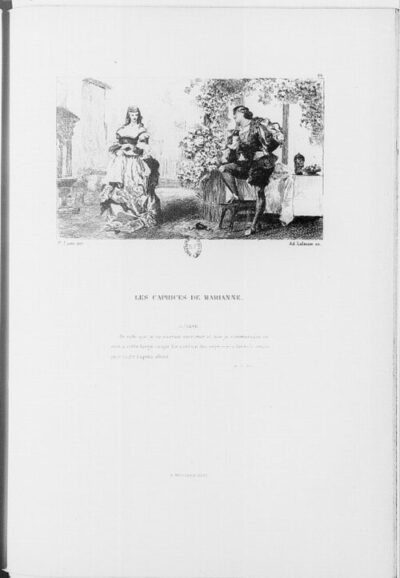
Picture: Eugène Lami ., via Wikimedia Commons · Public domain