The Postman Always Rings Twice
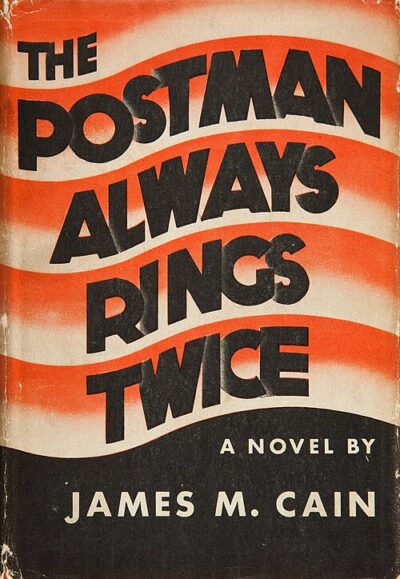
The Postman Always Rings Twice is a novel by James M. Cain. It came out in 1934.
- Published
- 1934
- Written by
- James M. Cain
- Genre
- crime literature
- Country of origin
- United States
All 7 facts, and where they come from
Facts
7 facts · 0 confirmed by two sources · 0 cited · 7 from one source
Where this comes from
Papalocal keeps its own record. It started from these sources; what each one said is kept here as it was copied, so a change on their side never changes this page by itself. Tap one to read its version.
What Wikidata says · copied November 17, 2026 · revision 2502699267
- Described as
- novel by James M. Cain
- What it is
- written work
- Written by
- James M. Cain
- Publisher
- Alfred A. Knopf
- Genre
- crime literature
- Published
- 1934
- Language
- English
- Country of origin
- United States
- Wikipedias with a page
- 22
Wikidata item Q934430 (wikidata.org/wiki/Q934430), public domain (CC0). Copied 2026-11-17.
What Wikipedia says · copied November 17, 2026 · revision 1384226111
The Postman Always Rings Twice is a 1934 crime novel by American writer James M. Cain. The novel became successful and notorious upon publication. It is considered one of the most outstanding crime novels of the 20th century. The novel's mix of frank sexuality and violence was startling in its time and caused it to be banned in Boston.
It is included in the Modern Library's list of the 100 best novels, and it was published as an Armed Services Edition during World War II. The novel has been adapted for the screen seven times; the first American film version, released in 1946, is regarded as an important film noir.
The story owes a clear debt to Émile Zola's 1868 novel Thérèse Raquin, which has a similar plot.
From the Wikipedia article “The Postman Always Rings Twice (novel)” (en.wikipedia.org/wiki/The_Postman_Always_Rings_Twice_(novel)), by its contributors, under CC BY-SA 4.0 (creativecommons.org/licenses/by-sa/4.0/). Copied 2026-11-17; not changed.
Confirmed Two sources agree. Cited One source, and it names where it got it. One source One source, without a reference of its own. Sources disagree The sources disagree. We show the best-supported value and keep theirs below.
Picture: Unknown author, via Wikimedia Commons · Public domain