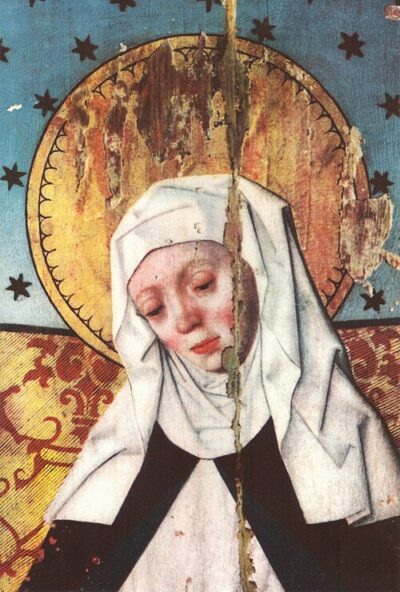
The Revelations of Saint Birgitta of Sweden
The Revelations of Saint Birgitta of Sweden is a book by Birgitta van Zweden. It was written by Bridget of Sweden.
- Came out
- 14th century
- Written by
- Bridget of Sweden
- Genre
- devotional literature
- Country of origin
- Sweden
All 6 facts, and where they come from
Facts
6 facts · 0 confirmed by two sources · 0 cited · 6 from one source
Where this comes from
Papalocal keeps its own record. It started from these sources; what each one said is kept here as it was copied, so a change on their side never changes this page by itself. Tap one to read its version.
What Wikidata says · copied November 17, 2026 · revision 2538367056
- Described as
- book by Birgitta van Zweden
- What it is
- literary work
- Written by
- Bridget of Sweden
- Genre
- devotional literature
- Language
- medieval Latin
- Country of origin
- Sweden
- Came out
- 14th century
- Wikipedias with a page
- 5
Wikidata item Q10524177 (wikidata.org/wiki/Q10524177), public domain (CC0). Copied 2026-11-17.
What Wikipedia says · copied November 17, 2026 · revision 1385024865
The Revelations of Saint Birgitta of Sweden, or Heavenly Revelations (Latin: Revelationes celestes) is a large 14th-century book by Saint Birgitta of Sweden, a mystic and prophet.
The Revelations were written down between the years 1344 and 1373, in Latin by Petrus of Alvastra, Petrus of Skänninge and Alfonso of Jaén, either based on the Old Swedish originals or on the recitation of Birgitta. The work was printed first time in 1492 by Bartholomaeus Ghotan in Lübeck.
The work contains about 700 revelations in eight books, besides Revelationes extravagantes as supplement. The "Revelations" have been translated into most European languages and into Arabic. The first complete translation in English, The Revelations of St. Birgitta of Sweden, was made by Denis Searby.
Their content touches also on most of the political conflicts and ecclesiastical matters and debates of the time: the Avignon Papacy, the Hundred Years’ War, the legitimacy of secular and ecclesiastical rulers, the state of the priesthood, the Immaculate Conception of the Virgin Mary, apostolic life, the authenticity of relics, the Eucharist, and several other subjects. According to the Swedish church historian Herman Lundström (1952), Birgitta's revelations "contain a pure mysticism, rich in thought, and marked by deep insight into the inner mysteries of the devout life." They also " show traces of admirable anticipations of Reformation ideas. The conception of the universal priesthood appears here and there; in her personal devotion, she goes back to the eternal source of life and truth; and her rule commends the preaching of the Word to the people in the vernacular."
From the Wikipedia article “The Revelations of Saint Birgitta of Sweden” (en.wikipedia.org/wiki/The_Revelations_of_Saint_Birgitta_of_Sweden), by its contributors, under CC BY-SA 4.0 (creativecommons.org/licenses/by-sa/4.0/). Copied 2026-11-17; not changed.
Confirmed Two sources agree. Cited One source, and it names where it got it. One source One source, without a reference of its own. Sources disagree The sources disagree. We show the best-supported value and keep theirs below.