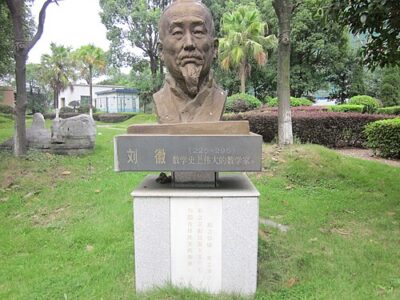
The Sea Island Mathematical Manual
The Sea Island Mathematical Manual is an ancient Chinese treatise on surveying. It came out in 263. It was written by Liu Hui.
- Published
- 263
- Written by
- Liu Hui
All 5 facts, and where they come from
Facts
5 facts · 0 confirmed by two sources · 2 cited · 3 from one source
Where this comes from
Papalocal keeps its own record. It started from these sources; what each one said is kept here as it was copied, so a change on their side never changes this page by itself. Tap one to read its version.
What Wikidata says · copied November 17, 2026 · revision 2547392855
- Described as
- ancient Chinese treatise on surveying
- Other names
- 海島算經
- What it is
- literary work; written work
- Written by
- Liu Hui · 1 reference
- Published
- 263 · 1 reference
- Language
- Classical Chinese
- Wikipedias with a page
- 6
Wikidata item Q7762765 (wikidata.org/wiki/Q7762765), public domain (CC0). Copied 2026-11-17.
What Wikipedia says · copied November 17, 2026 · revision 1369381105
Haidao Suanjing (海島算經; The Island Mathematical Manual) was written by the Chinese mathematician Liu Hui of the Three Kingdoms era (220–280) as an extension of chapter 9 of The Nine Chapters on the Mathematical Art.
During the Tang dynasty (618–907), this appendix was taken out from The Nine Chapters on the Mathematical Art as a separate book, titled Haidao suanjing
(Sea Island Mathematical Manual), named after problem No 1 "Looking at a sea island." In the time of the early Tang dynasty, Haidao Suanjing was selected into one of The Ten Computational Canons as the official mathematical texts for imperial examinations in mathematics.
From the Wikipedia article “Haidao Suanjing” (en.wikipedia.org/wiki/Haidao_Suanjing), by its contributors, under CC BY-SA 4.0 (creativecommons.org/licenses/by-sa/4.0/). Copied 2026-11-17; not changed.
Confirmed Two sources agree. Cited One source, and it names where it got it. One source One source, without a reference of its own. Sources disagree The sources disagree. We show the best-supported value and keep theirs below.