The Seven Deadly Sins and the Four Last Things
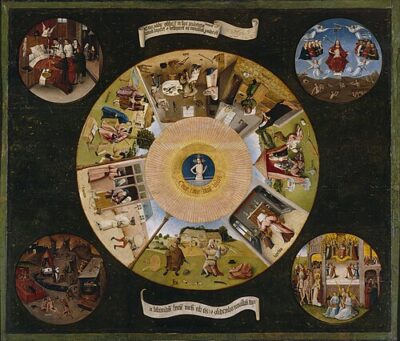
The Seven Deadly Sins and the Four Last Things is a paintings by Hieronymus Bosch or a follower.
- Came out
- 16th century
- Created by
- Hieronymus Bosch
- Genre
- religious art
All 5 facts, and where they come from
Facts
5 facts · 0 confirmed by two sources · 3 cited · 2 from one source
Where this comes from
Papalocal keeps its own record. It started from these sources; what each one said is kept here as it was copied, so a change on their side never changes this page by itself. Tap one to read its version.
What Wikidata says · copied November 17, 2026 · revision 2569622695
- Described as
- paintings by Hieronymus Bosch or a follower
- What it is
- painting · 1 reference
- Created by
- Hieronymus Bosch
- Genre
- religious art · 1 reference
- Came out
- 16th century · 1 reference
- Country
- Burgundian Netherlands
- Wikipedias with a page
- 24
Wikidata item Q2304870 (wikidata.org/wiki/Q2304870), public domain (CC0). Copied 2026-11-17.
What Wikipedia says · copied November 17, 2026 · revision 1382202307
The Seven Deadly Sins and the Four Last Things is a painting attributed to the Early Netherlandish artist Hieronymus Bosch or to a follower of his, completed around 1500 or later. Since 1898 its authenticity has been questioned several times. In 2015 the Bosch Research Conservation Project claimed it to be by a follower, but scholars at the Prado, where the painting is on display in a sealed case, dismissed this argument. The painting is oil on wooden panels and is presented in a series of circular images.
Four small circles, detailing the four last things—Death, Judgment, Heaven, and Hell—surround a larger circle in which the seven deadly sins are depicted: wrath at the bottom, then (proceeding clockwise) envy, greed, gluttony, sloth, extravagance (later replaced with lust), and pride, using scenes from life rather than allegorical representations of the sins.
At the centre of the large circle, which is said to represent the eye of God, is a "pupil" in which Christ can be seen emerging from his tomb. Below this image is the Latin inscription Cave cave d[omi]n[u]s videt ("Beware, Beware, The Lord Sees").
Above and below the central image are inscription in Latin of Deuteronomy 32:28–29, containing the lines "For they are a nation void of counsel, neither is there any understanding in them", above, and "O that they were wise, that they understood this, that they would consider their latter end!" below.
From the Wikipedia article “The Seven Deadly Sins and the Four Last Things” (en.wikipedia.org/wiki/The_Seven_Deadly_Sins_and_the_Four_Last_Things), by its contributors, under CC BY-SA 4.0 (creativecommons.org/licenses/by-sa/4.0/). Copied 2026-11-17; not changed.
Confirmed Two sources agree. Cited One source, and it names where it got it. One source One source, without a reference of its own. Sources disagree The sources disagree. We show the best-supported value and keep theirs below.
Picture: Hieronymus Bosch or follower, via Wikimedia Commons · Public domain