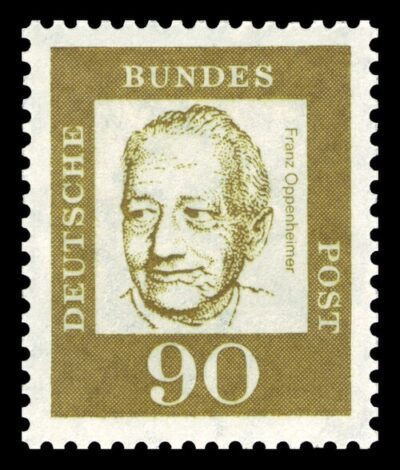
The State
The State is a book by German sociologist Franz Oppenheimer. It came out in 1908.
- Published
- 1908
- Written by
- Franz Oppenheimer
- Genre
- non-fiction literature
- Country of origin
- German Empire
All 6 facts, and where they come from
Facts
6 facts · 0 confirmed by two sources · 0 cited · 6 from one source
Where this comes from
Papalocal keeps its own record. It started from these sources; what each one said is kept here as it was copied, so a change on their side never changes this page by itself. Tap one to read its version.
What Wikidata says · copied November 17, 2026 · revision 2528507623
- Described as
- book by German sociologist Franz Oppenheimer
- What it is
- literary work
- Written by
- Franz Oppenheimer
- Genre
- non-fiction literature
- Published
- 1908
- Language
- German
- Country of origin
- German Empire · 1 reference
- Wikipedias with a page
- 5
Wikidata item Q5236462 (wikidata.org/wiki/Q5236462), public domain (CC0). Copied 2026-11-17.
What Wikipedia says · copied November 17, 2026 · revision 1384314270
The State (German: Der Staat) is a book by German sociologist Franz Oppenheimer first published in Germany in 1907. Oppenheimer wrote the book in Frankfurt am Main during 1907, as a fragment of the four-volume System of Sociology, an intended interpretative framework for the understanding of social evolution on which he laboured from the 1890s until the end of his life. The work summarizes Oppenheimer's general theory on the origin, development and future transformation of the state. The State, which Oppenheimer's missionary zeal pervades, was widely read and passionately discussed in the early 20th century. It was well received by—and influential on—as diverse an audience as Zionist settlers in Palestine (halutzim), American and Slavic communitarians, West German Chancellor Ludwig Erhard, and anarcho-capitalists like Murray Rothbard.
A classical liberal and socialist sympathiser, Oppenheimer regarded capitalism as "a system of exploitation and capital revenues as the gain of that exploitation", but placed the blame not on the genuinely free market, but on the intervention of the state. Oppenheimer's view of the state is profoundly opposed to the then dominant characterisation propounded by G. W. F. Hegel of the state as an admirable achievement of modern civilisation. Proponents of this view tend to accept the social contract view that the State came about as ever larger groups of people agreed to subordinate their private interests for the common good.
In contrast, Oppenheimer's view was an advancement of the "conquest theory" of the state that developed during the late 19th century by Ludwig Gumplowicz. According to conquest theory, the state came into being through war and conquest, a consequence of which was the establishment of social classes; the dominant conquerors and the subordinate conquered. This, in turn, led to the emergence of a political system to consolidate the power of the conquerors, to perpetuate and regulate class divisions. Oppenheimer's views led the American essayist, Albert Jay Nock, writing in the first half of the 20th century, to remark that in his own book, Our Enemy, the State:Taking the State wherever found, striking into its history at any point, one sees no way to differentiate the activities of its founders, administrators and beneficiaries from those of a professional-criminal class.
From the Wikipedia article “The State (book)” (en.wikipedia.org/wiki/The_State_(book)), by its contributors, under CC BY-SA 4.0 (creativecommons.org/licenses/by-sa/4.0/). Copied 2026-11-17; not changed.
Confirmed Two sources agree. Cited One source, and it names where it got it. One source One source, without a reference of its own. Sources disagree The sources disagree. We show the best-supported value and keep theirs below.
Picture: Wikimedia Commons: Der Staat by F. Oppenheimer.jpg · See Commons file page