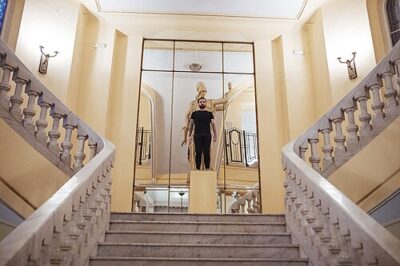
The Streets
The Streets is a Performance art by Abel Azcona.
- Created by
- Abel Azcona
All 3 facts, and where they come from
Facts
3 facts · 0 confirmed by two sources · 0 cited · 3 from one source
Where this comes from
Papalocal keeps its own record. It started from these sources; what each one said is kept here as it was copied, so a change on their side never changes this page by itself. Tap one to read its version.
What Wikidata says · copied November 17, 2026 · revision 2187826750
- Described as
- Performance art by Abel Azcona
- What it is
- work of art; performance artwork
- Created by
- Abel Azcona
- Wikipedias with a page
- 2
Wikidata item Q91655942 (wikidata.org/wiki/Q91655942), public domain (CC0). Copied 2026-11-17.
What Wikipedia says · copied November 17, 2026 · revision 1361434271
The Streets is a conceptual and performative work of critical and biographical content by artist Abel Azcona. At the end of 2014 and the early part of 2015, Azcona explored the processual work La Calle ("the sexual exchange") this time in the Santa Fe locality of Bogotá, where he prostituted himself on the streets. In this new work, he explored a change towards the figure of his mother, taking hormones and engaging in prostitution. Azcona was inspired by his biological mother, a prostitute, and sought to empathise with her and with the moment of his own conception. The process continued in the cities of Madrid and Mexico City. The performance emerged, as with the rest of his sex-themed works, as an exercise in empathy with his own biological mother. It was also a social critique, where the artist explored the limits of his body by repeating patterns of sexual abuse, which occurred in his own childhood and in the life of his mother.
From the Wikipedia article “The Streets (performance art)” (en.wikipedia.org/wiki/The_Streets_(performance_art)), by its contributors, under CC BY-SA 4.0 (creativecommons.org/licenses/by-sa/4.0/). Copied 2026-11-17; not changed.
Confirmed Two sources agree. Cited One source, and it names where it got it. One source One source, without a reference of its own. Sources disagree The sources disagree. We show the best-supported value and keep theirs below.