The Thing
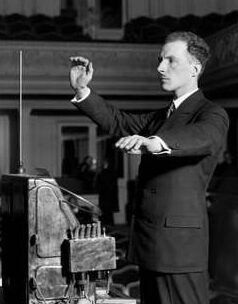
The Thing is an Audio bug formerly hidden in Moscow US embassy. It was created by Leon Theremin. It is given by the Young Pioneer Organization of the Soviet Union.
- Created by
- Leon Theremin
All 4 facts, and where they come from
Facts
4 facts · 0 confirmed by two sources · 0 cited · 4 from one source
Where this comes from
Papalocal keeps its own record. It started from these sources; what each one said is kept here as it was copied, so a change on their side never changes this page by itself. Tap one to read its version.
What Wikidata says · copied November 17, 2026 · revision 2493872825
- Described as
- Audio bug formerly hidden in Moscow US embassy
- Other names
- The Great Seal bug, Thing, Great Seal bug, The Thing (listening device)
- What it is
- covert listening device; microwave cavity
- Created by
- Leon Theremin
- Given by
- Young Pioneer Organization of the Soviet Union (1945)
- Wikipedias with a page
- 15
Wikidata item Q1628577 (wikidata.org/wiki/Q1628577), public domain (CC0). Copied 2026-11-17.
What Wikipedia says · copied November 17, 2026 · revision 1384447756
The Thing, also known as the Great Seal bug, was one of the first covert listening devices (or "bugs") to use passive techniques to transmit an audio signal. It was concealed inside a gift given by the Soviet Union to W. Averell Harriman, the United States Ambassador to the Soviet Union, on August 4, 1945. Because it was passive, needing electromagnetic energy from an outside source to become energized and active, it is considered a predecessor of radio-frequency identification (RFID) technology.
The Thing consisted of a tiny capacitive membrane connected to a small quarter-wavelength antenna; it had no power supply or active electronic components. The device, a passive cavity resonator, became active only when a radio signal of the correct frequency was sent to the device from an external transmitter. This is referred to in National Security Agency (NSA) parlance as "illuminating" a passive device. Sound waves (from voices inside the ambassador's office) passed through the thin wood case, striking the membrane and causing it to vibrate. The movement of the membrane varied the capacitance "seen" by the antenna, which in turn modulated the radio waves that struck and were re-transmitted by The Thing. A receiver demodulated the signal so that sound picked up by the microphone could be heard, just as an ordinary radio receiver demodulates radio signals and outputs sound.
Its design made the listening device very difficult to detect, because it was very small, had no power supply or active electronic components, and did not radiate any signal unless it was actively being irradiated remotely. These same design features, along with the overall simplicity of the device, made it very reliable and gave it a potentially unlimited operational life.
From the Wikipedia article “The Thing (listening device)” (en.wikipedia.org/wiki/The_Thing_(listening_device)), by its contributors, under CC BY-SA 4.0 (creativecommons.org/licenses/by-sa/4.0/). Copied 2026-11-17; not changed.
Confirmed Two sources agree. Cited One source, and it names where it got it. One source One source, without a reference of its own. Sources disagree The sources disagree. We show the best-supported value and keep theirs below.