The Two Gentlemen of Verona
The Two Gentlemen of Verona is a play by William Shakespeare. It came out in 1591.
- Came out
- 1591
- Written by
- William Shakespeare
- Genre
- Shakespearean comedy
All 5 facts, and where they come from
Facts
5 facts · 0 confirmed by two sources · 0 cited · 5 from one source
Where this comes from
Papalocal keeps its own record. It started from these sources; what each one said is kept here as it was copied, so a change on their side never changes this page by itself. Tap one to read its version.
What Wikidata says · copied November 17, 2026 · revision 2559592927
- Described as
- play by William Shakespeare
- Other names
- Two Gentlemen of Verona
- What it is
- dramatic work
- Written by
- William Shakespeare
- Genre
- Shakespearean comedy
- Language
- English
- Came out
- 1591
- Wikipedias with a page
- 53
Wikidata item Q232042 (wikidata.org/wiki/Q232042), public domain (CC0). Copied 2026-11-17.
What Wikipedia says · copied November 17, 2026 · revision 1385200693
The Two Gentlemen of Verona is a comedy by William Shakespeare, believed to have been written between 1589 and 1593. It is considered by some to be Shakespeare's first play, and is often seen as showing his first tentative steps in laying out some of the themes and motifs with which he would later deal in more detail; for example, it is the first of his plays in which a heroine dresses as a boy. The play deals with the themes of friendship and infidelity, the conflict between friendship and love, and the foolish behaviour of people in love. The highlight of the play is considered by some to be Launce, the clownish servant of Proteus, and his dog Crab, to whom "the most scene-stealing non-speaking role in the canon" has been attributed.
Two Gentlemen is often regarded as one of Shakespeare's weakest plays. It has the smallest named cast of any play by Shakespeare.
From the Wikipedia article “The Two Gentlemen of Verona” (en.wikipedia.org/wiki/The_Two_Gentlemen_of_Verona), by its contributors, under CC BY-SA 4.0 (creativecommons.org/licenses/by-sa/4.0/). Copied 2026-11-17; not changed.
Confirmed Two sources agree. Cited One source, and it names where it got it. One source One source, without a reference of its own. Sources disagree The sources disagree. We show the best-supported value and keep theirs below.
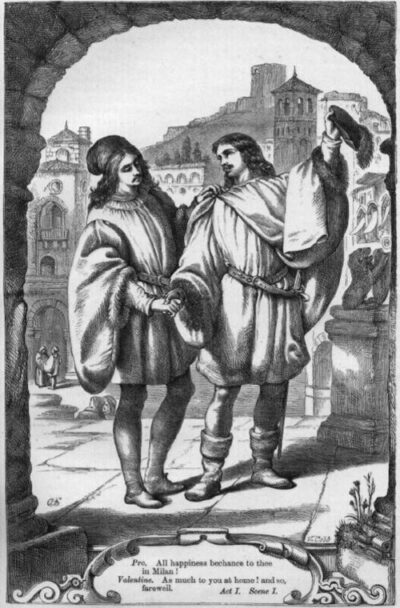
Picture: Henry Courtney Selous, via Wikimedia Commons · Public domain