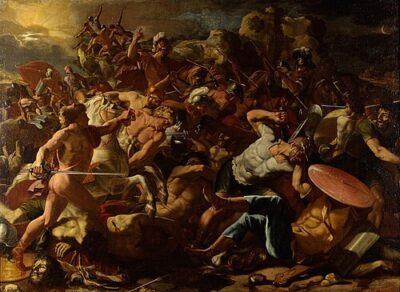
The Victory of Joshua over the Amorites
The Victory of Joshua over the Amorites is a painting by Nicolas Poussin.
- Came out
- 1620s
- Created by
- Nicolas Poussin
- Genre
- religious art
All 6 facts, and where they come from
Facts
6 facts · 0 confirmed by two sources · 1 cited · 5 from one source
Where this comes from
Papalocal keeps its own record. It started from these sources; what each one said is kept here as it was copied, so a change on their side never changes this page by itself. Tap one to read its version.
What Wikidata says · copied November 17, 2026 · revision 2398295551
- Described as
- painting by Nicolas Poussin
- What it is
- painting · 1 reference
- Created by
- Nicolas Poussin
- Genre
- religious art
- Based on
- Joshua
- Came out
- 1620s · 1 reference
- Country
- France
- Wikipedias with a page
- 7
Wikidata item Q56256003 (wikidata.org/wiki/Q56256003), public domain (CC0). Copied 2026-11-17.
What Wikipedia says · copied November 17, 2026 · revision 1367351943
The Battle between the Israelites and the Amorites, Joshua's Battle Against the Amorites or Joshua's Victory over the Amorites is a c. 1625 oil-on-canvas painting by the French artist Nicolas Poussin, now in the Pushkin Museum, in Moscow.
It was produced as a pendant to Joshua's Battle against the Amalekites by the same artist during his time in Rome. He fell into dire financial straits after the 1625 death of his patron, the poet Giovan Battista Marino and Cardinal Francesco Barberini's departure from the city – this forced him to sell both works. They were both acquired by Catherine II of Russia to be kept in Poussin's cousin Gaspard Dughet's home on via Paolina in Rome. The pair was split up in 1927.
From the Wikipedia article “The Battle between the Israelites and the Amorites” (en.wikipedia.org/wiki/The_Battle_between_the_Israelites_and_the_Amorites), by its contributors, under CC BY-SA 4.0 (creativecommons.org/licenses/by-sa/4.0/). Copied 2026-11-17; not changed.
Confirmed Two sources agree. Cited One source, and it names where it got it. One source One source, without a reference of its own. Sources disagree The sources disagree. We show the best-supported value and keep theirs below.
Picture: Nicolas Poussin, via Wikimedia Commons · Public domain