The Woman in the Dunes
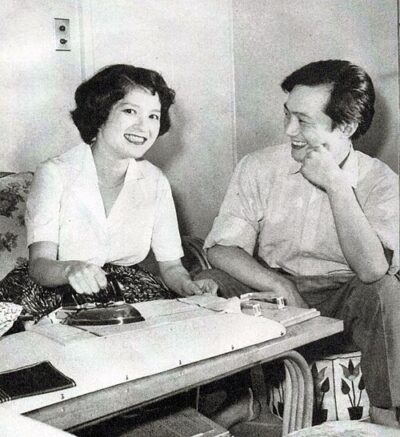
The Woman in the Dunes is a 1964 Japanese film directed by Hiroshi Teshigahara. It stars Eiji Okada and Kyōko Kishida. It won the Jury Prize.
- Released
- February 15, 1964
- Directed by
- Hiroshi Teshigahara
- Genre
- drama film
- Country of origin
- Japan
All 12 facts, and where they come from
Facts
12 facts · 0 confirmed by two sources · 3 cited · 9 from one source
Where this comes from
Papalocal keeps its own record. It started from these sources; what each one said is kept here as it was copied, so a change on their side never changes this page by itself. Tap one to read its version.
What Wikidata says · copied November 18, 2026 · revision 2563437674
- Described as
- 1964 Japanese film directed by Hiroshi Teshigahara
- Other names
- Woman in the Dunes, Suna no onna, Sand Woman
- What it is
- film
- Directed by
- Hiroshi Teshigahara · 2 references
- Music by
- Tōru Takemitsu
- Screenplay by
- Kōbō Abe
- Starring
- Eiji Okada · 2 references; Kyōko Kishida
- Genre
- drama film
- Released
- February 15, 1964 · 1 reference; October 25, 1964 · 1 reference
- Original language
- Japanese
- Country of origin
- Japan
- Based on
- The Woman in the Dunes
- Awards
- Jury Prize (1964)
- Wikipedias with a page
- 28
Wikidata item Q1207936 (wikidata.org/wiki/Q1207936), public domain (CC0). Copied 2026-11-18.
What Wikipedia says · copied November 18, 2026 · revision 1386299752
Woman in the Dunes or Woman of the Dunes (Japanese: 砂の女, Hepburn: Suna no Onna; lit. 'Sand Woman') is a 1964 Japanese drama film directed by Hiroshi Teshigahara and written by Kobo Abe. It stars Eiji Okada, Kyōko Kishida, and Kōji Mitsui. Associated with the Japanese New Wave, it received widespread critical acclaim and was nominated for two Academy Awards. The screenplay for the film was adapted by Abe from his 1962 novel of the same name.
Woman in the Dunes was an independent, joint production of Teshigahara Productions and the Japanese Art Theater Guild, a group of young filmmakers involved in an attempt to create political–aesthetical films in opposition to the dominant studio productions of the 1960s, which they viewed as commercial, unartistic, and uninteresting.
The film is considered to be Teshigahara's masterpiece and one of the best movies of Japanese cinema and the 20th century. After modern evaluation, it is now widely regarded as one of the greatest films of all time. The film is also seen as one of the most ambiguous, cryptic and enigmatic movies ever made. It is one of Russian filmmaker Andrei Tarkovsky's top ten favorite movies of all time. Glenn Gould explicitly tracked the cinematic framing, stating he would "see this film forty or fifty times and study literally every shot in the film," specifically pointing to Woman in the Dunes as "quite possibly the greatest film ever made."
From the Wikipedia article “Woman in the Dunes” (en.wikipedia.org/wiki/Woman_in_the_Dunes), by its contributors, under CC BY-SA 4.0 (creativecommons.org/licenses/by-sa/4.0/). Copied 2026-11-18; not changed.
Confirmed Two sources agree. Cited One source, and it names where it got it. One source One source, without a reference of its own. Sources disagree The sources disagree. We show the best-supported value and keep theirs below.
Picture: Wikimedia Commons: Eiga-Hyoron-1965-March-3.jpg · See Commons file page