

Thelema
Thelema is an occult philosophy developed by Aleister Crowley. It came out in 1904.
- Came out
- 1904
- Created by
- Aleister Crowley
All 3 facts, and where they come from
Facts
3 facts · 0 confirmed by two sources · 0 cited · 3 from one source
Where this comes from
Papalocal keeps its own record. It started from these sources; what each one said is kept here as it was copied, so a change on their side never changes this page by itself. Tap one to read its version.
What Wikidata says · copied November 17, 2026 · revision 2561567924
- Described as
- occult philosophy developed by Aleister Crowley
- What it is
- religion
- Created by
- Aleister Crowley
- Came out
- 1904
- Wikipedias with a page
- 43
Wikidata item Q745955 (wikidata.org/wiki/Q745955), public domain (CC0). Copied 2026-11-17.
What Wikipedia says · copied November 17, 2026 · revision 1378640518
Thelema () is a Western esoteric and occult social and spiritual philosophy, and a new religious movement. It was founded in the early 1900s by Aleister Crowley (1875–1947), an English writer, mystic, occultist, and ceremonial magician. Central to Thelema is the concept of discovering and following one's True Will, a divine and individual purpose that transcends ordinary desires. Crowley's system begins with The Book of the Law, a text he maintained was dictated to him by a non-corporeal entity named Aiwass. This work outlines key principles, including the axioms "Do what thou wilt shall be the whole of the Law" and "love is the law, love under will", emphasizing personal freedom and the pursuit of one's true path.
The Thelemic cosmology features deities inspired by ancient Egyptian religion. The highest deity is Nuit, the night sky symbolized as a naked woman covered in stars, representing the ultimate source of possibilities. Hadit, the infinitely small point, symbolizes manifestation and motion. Ra-Hoor-Khuit, who is believed to be a form of Horus, represents the Sun and active energies of Thelemic magick. Crowley believed that discovering and following one's True Will is the path to self-realization and personal fulfillment, often referred to as the Great Work. The Creed of the Gnostic Mass also professes a belief in Chaos, Babalon, and Baphomet.
Magick is a central practice in Thelema, involving various physical, mental, and spiritual exercises aimed at uncovering one's True Will and enacting change in alignment with it. Practices such as rituals, yoga, and meditation are used to explore consciousness and achieve self-mastery. The Gnostic Mass, a central ritual in Thelema, mirrors traditional religious services but conveys Thelemic principles. Thelemites also observe specific holy days, such as the Equinoxes and the Feast of the Three Days of the Writing of the Book of the Law, commemorating the writing of Thelema's foundational text.
Post-Crowley figures like Jack Parsons, Kenneth Grant, James Lees, and Nema Andahadna have further developed Thelema, introducing new ideas, practices, and interpretations. Parsons conducted the Babalon Working to invoke the goddess Babalon, while Grant synthesized various traditions into his Typhonian Order. Lees created the English Qaballa, and Nema Andahadna developed Maat Magick.
From the Wikipedia article “Thelema” (en.wikipedia.org/wiki/Thelema), by its contributors, under CC BY-SA 4.0 (creativecommons.org/licenses/by-sa/4.0/). Copied 2026-11-17; not changed.
Confirmed Two sources agree. Cited One source, and it names where it got it. One source One source, without a reference of its own. Sources disagree The sources disagree. We show the best-supported value and keep theirs below.
Picture: Wikimedia Commons: Aleister Crowley, Magus.png · See Commons file page
People connected 3
Religion
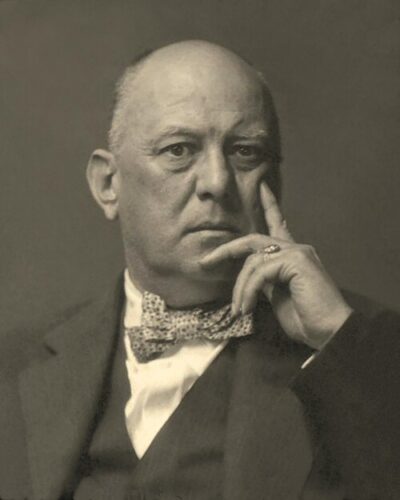 Aleister CrowleyEnglish occultist (1875–1947)
 Jack ParsonsAmerican rocket engineer (1914–1952)
 Noname JaneAmerican pornographic actress
