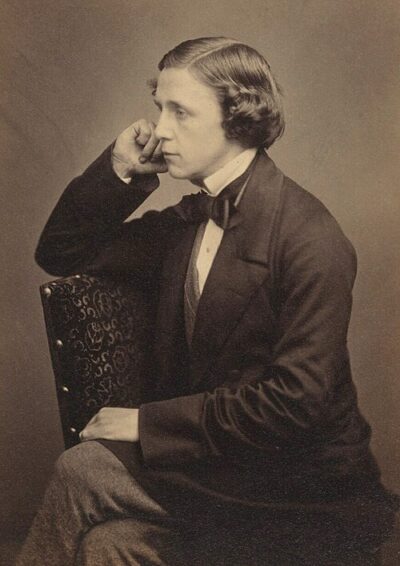
Through the Looking-Glass
Through the Looking-Glass is a 1871 children's novel by Lewis Carroll.
- Published
- 1871
- Written by
- Lewis Carroll
- Genre
- fantasy
- Country of origin
- United Kingdom of Great Britain and Ireland
All 8 facts, and where they come from
Facts
8 facts · 0 confirmed by two sources · 1 cited · 7 from one source
Where this comes from
Papalocal keeps its own record. It started from these sources; what each one said is kept here as it was copied, so a change on their side never changes this page by itself. Tap one to read its version.
What Wikidata says · copied November 17, 2026 · revision 2570264356
- Described as
- 1871 children's novel by Lewis Carroll
- Other names
- Alice Through the Looking-Glass, Through the Looking-Glass, and What Alice Found There, Through the Looking‐Glass and What Alice Found There
- What it is
- literary work
- Written by
- Lewis Carroll · 1 reference
- Publisher
- Macmillan Publishers
- Genre
- fantasy
- Published
- 1871
- Language
- English
- Country of origin
- United Kingdom of Great Britain and Ireland
- Comes after
- Alice's Adventures in Wonderland
- Wikipedias with a page
- 61
Wikidata item Q220331 (wikidata.org/wiki/Q220331), public domain (CC0). Copied 2026-11-17.
What Wikipedia says · copied November 17, 2026 · revision 1384221156
Through the Looking-Glass, and What Alice Found There is a novel published in December 1871 by Lewis Carroll, the pen name of Charles Lutwidge Dodgson, a mathematics lecturer at Christ Church, Oxford. It is the sequel to his Alice's Adventures in Wonderland (1865), in which many of the characters were anthropomorphic playing cards. In this second novel the theme is chess. As in the earlier book, the central figure, Alice, enters a fantastical world, this time by climbing through a large looking-glass (a mirror) into a world that she can see beyond it. There she finds that, just as in a reflection, things are reversed, including logic (for example, running helps one remain stationary, walking away from something brings one towards it, chessmen are alive and nursery-rhyme characters are real).
Among the characters Alice meets are the severe Red Queen, the gentle and flustered White Queen, the quarrelsome twins Tweedledum and Tweedledee, the rude and opinionated Humpty Dumpty, and the kindly but impractical White Knight. Eventually, as in the earlier book, after a succession of strange adventures, Alice wakes and realises she has been dreaming. As in Alice's Adventures in Wonderland, the original illustrations are by John Tenniel.
The book contains several verse passages, including "Jabberwocky", "The Walrus and the Carpenter" and the White Knight's ballad, "A-sitting on a Gate". Like Alice's Adventures in Wonderland, the book introduces phrases that have become common currency, including "jam to-morrow and jam yesterday – but never jam to-day", "sometimes I've believed as many as six impossible things before breakfast", "un-birthday presents", "portmanteau words" and "as large as life and twice as natural".
Through the Looking Glass has been adapted for the stage and the screen and translated into many languages. Critical opinion of the book has generally been favourable and either ranked it on a par with its predecessor or else only just short of it.
From the Wikipedia article “Through the Looking-Glass” (en.wikipedia.org/wiki/Through_the_Looking-Glass), by its contributors, under CC BY-SA 4.0 (creativecommons.org/licenses/by-sa/4.0/). Copied 2026-11-17; not changed.
Confirmed Two sources agree. Cited One source, and it names where it got it. One source One source, without a reference of its own. Sources disagree The sources disagree. We show the best-supported value and keep theirs below.
Picture: Wikimedia Commons: Through the looking glass.jpg · See Commons file page