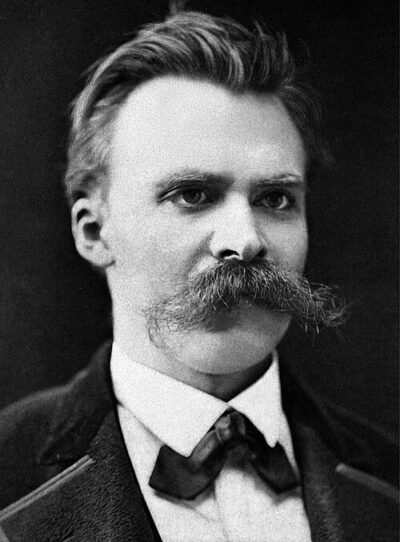
Thus Spoke Zarathustra
Thus Spoke Zarathustra is a philosophical novel by Friedrich Nietzsche. It came out in 1885.
- Published
- 1885
- Came out
- 1883
- Written by
- Friedrich Nietzsche
- Genre
- philosophical novel
- Country of origin
- Germany
All 10 facts, and where they come from
Facts
10 facts · 0 confirmed by two sources · 0 cited · 10 from one source
Where this comes from
Papalocal keeps its own record. It started from these sources; what each one said is kept here as it was copied, so a change on their side never changes this page by itself. Tap one to read its version.
What Wikidata says · copied November 17, 2026 · revision 2546565183
- Described as
- philosophical novel by Friedrich Nietzsche
- Other names
- Thus Spake Zarathustra
- What it is
- literary work
- Written by
- Friedrich Nietzsche · 1 reference
- Genre
- philosophical novel
- Published
- 1885
- Language
- German
- Country of origin
- Germany
- Comes after
- Gay Science
- Followed by
- Beyond Good and Evil
- Came out
- 1883
- Named after
- Zoroaster
- Wikipedias with a page
- 80
Wikidata item Q199774 (wikidata.org/wiki/Q199774), public domain (CC0). Copied 2026-11-17.
What Wikipedia says · copied November 17, 2026 · revision 1384888010
Thus Spoke Zarathustra: A Book for All and None (German: Also sprach Zarathustra: Ein Buch für Alle und Keinen), also translated as Thus Spake Zarathustra, is a work of philosophical fiction written by German philosopher Friedrich Nietzsche and published in four volumes between 1883 and 1885. The protagonist is nominally the historical Zarathustra, more commonly called Zoroaster in the West.
Much of the book consists of discourses by Zarathustra on a wide variety of subjects, most of which end with the refrain "thus spoke Zarathustra." The character of Zarathustra first appeared in Nietzsche's earlier book The Gay Science (at §342, which closely resembles §1 of "Zarathustra's Prologue" in Thus Spoke Zarathustra).
The style of Nietzsche's Zarathustra has facilitated varied and often incompatible ideas about what Nietzsche's Zarathustra says. The "[e]xplanations and claims" given by the character of Zarathustra in this work "are almost always analogical and figurative." Though there is no consensus about what Zarathustra means when he speaks, there is some consensus about that which he speaks. Thus Spoke Zarathustra deals with multiple subjects ranging from the mundane to philosophical, such as metaphysics, war, perspectivism, and the amorality of nature; it also began or elaborated on many of Nietzsche's core ideas such as the Übermensch, the death of God, the will to power, and eternal recurrence.
From the Wikipedia article “Thus Spoke Zarathustra” (en.wikipedia.org/wiki/Thus_Spoke_Zarathustra), by its contributors, under CC BY-SA 4.0 (creativecommons.org/licenses/by-sa/4.0/). Copied 2026-11-17; not changed.
Confirmed Two sources agree. Cited One source, and it names where it got it. One source One source, without a reference of its own. Sources disagree The sources disagree. We show the best-supported value and keep theirs below.
Picture: Wikimedia Commons: Also sprach Zarathustra (1883).gif · See Commons file page