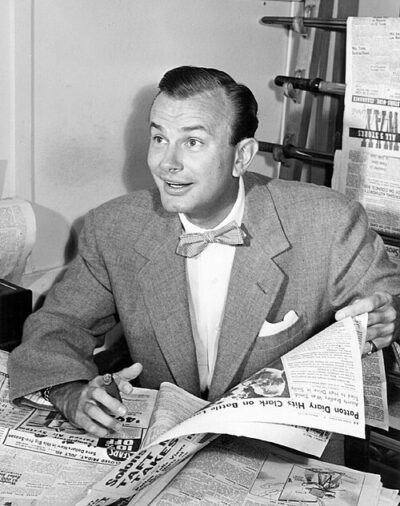
Tonight Starring Jack Paar
Tonight Starring Jack Paar is a television series. It was directed by Hal Gurnee. It stars José Melis. It is part of The Tonight Show.
- Directed by
- Hal Gurnee
- Country of origin
- United States
All 6 facts, and where they come from
Facts
6 facts · 0 confirmed by two sources · 0 cited · 6 from one source
Where this comes from
Papalocal keeps its own record. It started from these sources; what each one said is kept here as it was copied, so a change on their side never changes this page by itself. Tap one to read its version.
What Wikidata says · copied November 19, 2026 · revision 2513576414
- Described as
- television series
- What it is
- television series
- Directed by
- Hal Gurnee
- Starring
- José Melis · 1 reference
- Language
- English
- Country of origin
- United States
- Part of the series
- The Tonight Show
- Wikipedias with a page
- 3
Wikidata item Q7821460 (wikidata.org/wiki/Q7821460), public domain (CC0). Copied 2026-11-19.
What Wikipedia says · copied November 19, 2026 · revision 1384560366
Tonight Starring Jack Paar (in later seasons The Jack Paar Tonight Show) is an American television talk show broadcast by NBC. The show is the second installment of The Tonight Show. Hosted by Jack Paar, it aired from July 29, 1957, to March 30, 1962, replacing Tonight Starring Steve Allen and was replaced by The Tonight Show Starring Johnny Carson.
During most of its run it was broadcast from Studio 6B (formerly the home of Milton Berle's Texaco Star Theater series) inside 30 Rockefeller Plaza in New York City. The same studio later hosted early episodes of The Tonight Show Starring Johnny Carson, Late Night with Jimmy Fallon and The Tonight Show Starring Jimmy Fallon. Its theme song was an instrumental version of "Everything's Coming Up Roses", and the closing theme was "So Until I See You" by Al Lerner.
From the Wikipedia article “Tonight Starring Jack Paar” (en.wikipedia.org/wiki/Tonight_Starring_Jack_Paar), by its contributors, under CC BY-SA 4.0 (creativecommons.org/licenses/by-sa/4.0/). Copied 2026-11-19; not changed.
Confirmed Two sources agree. Cited One source, and it names where it got it. One source One source, without a reference of its own. Sources disagree The sources disagree. We show the best-supported value and keep theirs below.