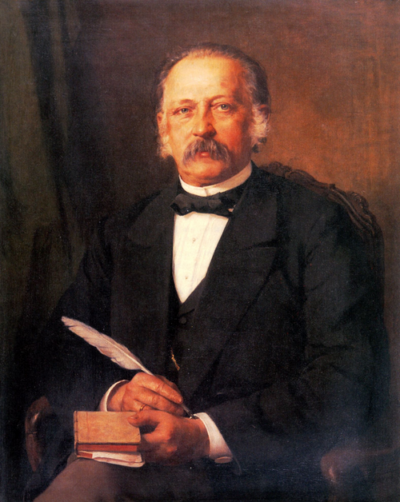
Tunnel über der Spree
Tunnel über der Spree is a German literary society based in Berlin, founded on 3 December 1827 by Moritz Gottlieb Saphir.
All 4 facts, and where they come from
Facts
4 facts · 0 confirmed by two sources · 0 cited · 4 from one source
Where this comes from
Papalocal keeps its own record. It started from these sources; what each one said is kept here as it was copied, so a change on their side never changes this page by itself. Tap one to read its version.
What Wikidata says · copied November 17, 2026 · revision 2569821504
- Described as
- German literary society based in Berlin, founded on 3 December 1827 by Moritz Gottlieb Saphir
- What it is
- organization
- Founded
- 1827
- Headquarters
- Berlin
- Country
- Germany
- Wikipedias with a page
- 4
Wikidata item Q2460101 (wikidata.org/wiki/Q2460101), public domain (CC0). Copied 2026-11-17.
What Wikipedia says · copied November 17, 2026 · revision 1357838517
Tunnel über der Spree was a German literary society based in Berlin, founded on 3 December 1827 by Moritz Gottlieb Saphir. Most active between 1840 and 1860, it acquired 214 members and influenced literary life in Berlin for more than seventy years.
Saphir had been denied membership of Julius Eduard Hitzig's new Wednesday Society. He invited the actors Friedrich Wilhelm Lemm and Ludwig Schneider to his home and founded a "Sunday Society" to compete with it. Its motto was Ungeheure Ironie und unendliche Wehmut and its mascot was Till Eulenspiegel.
To avoid confusion with fanclubs of the singer Henriette Sontag, the name was changed to "Tunnel over the Spree," a topical reference to Isambard Kingdom Brunel's tunnel under the Thames, which would lead to an abortive effort to create a similar tunnel in Berlin. In fact, the first Berlin tunnel did not open until 1899, the year after the demise of the society. Theodor Fontane, an important source of information on the society, once remarked that Saphir's only real intention was to create a kind of personal bodyguard for himself. Another member, Emanuel Geibel, described it as a "daycare centre for smalltime authors" (Kleindichterbewahranstalt).
The board consisted of a president, vice-president and secretary, and elections were held on 1 May and 1 November each year. Members met on Sunday afternoons in a cafe near St Hedwig's Cathedral in Unter den Linden, and presented their most recent unpublished creative efforts—usually poems, but occasionally music or even paintings. Membership was by invitation after three attendances as a guest; the new member had to select a pseudonym, which had to be the name of a famous deceased individual of the same profession. Although the purpose of the pseudonym was to help erase class distinctions, its membership consisted almost entirely of officers, aristocrats, and professional men: no women were permitted at meetings, and its formalities made its atmosphere very different from that of the salons which had preceded it.
The last minuted meeting took place on 30 October 1898. After the death in 1911 of the last president, Oscar Roloff, the society's archives were donated to Humboldt University in Berlin. Theodor Fontane vividly described the society's activities in his memoir Von Zwanzig bis Dreißig.
From the Wikipedia article “Tunnel über der Spree” (en.wikipedia.org/wiki/Tunnel_über_der_Spree), by its contributors, under CC BY-SA 4.0 (creativecommons.org/licenses/by-sa/4.0/). Copied 2026-11-17; not changed.
Confirmed Two sources agree. Cited One source, and it names where it got it. One source One source, without a reference of its own. Sources disagree The sources disagree. We show the best-supported value and keep theirs below.