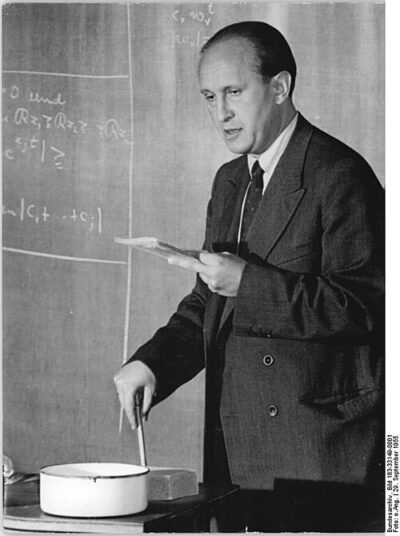
Turán's brick factory problem
Turán's brick factory problem is a finding the minimum number of crossings in a drawing of a complete bipartite graph.
All 2 facts, and where they come from
Facts
2 facts · 0 confirmed by two sources · 0 cited · 2 from one source
Where this comes from
Papalocal keeps its own record. It started from these sources; what each one said is kept here as it was copied, so a change on their side never changes this page by itself. Tap one to read its version.
What Wikidata says · copied November 17, 2026 · revision 2568722650
- Described as
- finding the minimum number of crossings in a drawing of a complete bipartite graph
- What it is
- mathematical problem
- Named after
- Pál Turán
- Wikipedias with a page
- 6
Wikidata item Q25303632 (wikidata.org/wiki/Q25303632), public domain (CC0). Copied 2026-11-17.
What Wikipedia says · copied November 17, 2026 · revision 1380788609
In the mathematics of graph drawing, Turán's brick factory problem asks for the minimum number of crossings in a drawing of a complete bipartite graph. The problem is named after Pál Turán, who formulated it while being forced to work in a brick factory during World War II.
A drawing method found by Kazimierz Zarankiewicz has been conjectured to give the correct answer for every complete bipartite graph, and the statement that this is true has come to be known as the Zarankiewicz crossing number conjecture. The conjecture remains open, with only some special cases solved.
From the Wikipedia article “Turán's brick factory problem” (en.wikipedia.org/wiki/Turán's_brick_factory_problem), by its contributors, under CC BY-SA 4.0 (creativecommons.org/licenses/by-sa/4.0/). Copied 2026-11-17; not changed.
Confirmed Two sources agree. Cited One source, and it names where it got it. One source One source, without a reference of its own. Sources disagree The sources disagree. We show the best-supported value and keep theirs below.