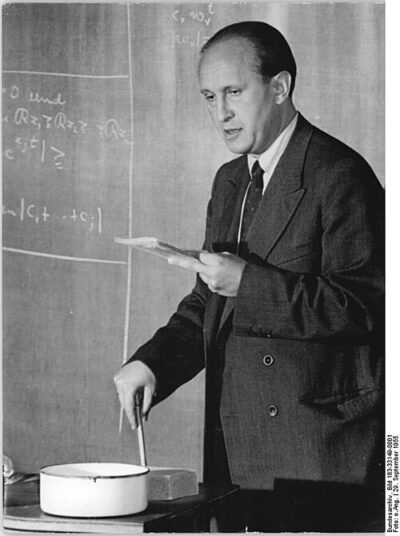
Turán's theorem
Turán's theorem is a theorem bounding the number of edges in a graph that has no large cliques.
All 2 facts, and where they come from
Facts
2 facts · 0 confirmed by two sources · 0 cited · 2 from one source
Where this comes from
Papalocal keeps its own record. It started from these sources; what each one said is kept here as it was copied, so a change on their side never changes this page by itself. Tap one to read its version.
What Wikidata says · copied November 17, 2026 · revision 2515891992
- Described as
- theorem bounding the number of edges in a graph that has no large cliques
- What it is
- theorem
- Named after
- Pál Turán
- Wikipedias with a page
- 11
Wikidata item Q1047749 (wikidata.org/wiki/Q1047749), public domain (CC0). Copied 2026-11-17.
What Wikipedia says · copied November 17, 2026 · revision 1373581004
In graph theory, Turán's theorem bounds the number of edges that can be included in an undirected graph that does not have a complete subgraph of a given size. It is one of the central results of extremal graph theory, an area studying the largest or smallest graphs with given properties, and is a special case of the forbidden subgraph problem on the maximum number of edges in a graph that does not have a given subgraph.
An example of an n-vertex graph that does not contain any (r+1)-vertex clique Kr+1 may be formed by partitioning the set of n vertices into r parts of equal or nearly equal size, and connecting two vertices by an edge whenever they belong to two different parts. The resulting graph is the Turán graph T(n,r). Turán's theorem states that the Turán graph has the largest number of edges among all Kr+1-free n-vertex graphs.
Turán's theorem, and the Turán graphs giving its extreme case, were first described and studied by Hungarian mathematician Pál Turán in 1941. The special case of the theorem for triangle-free graphs is known as Mantel's theorem; it was stated in 1907 by Willem Mantel, a Dutch mathematician.
From the Wikipedia article “Turán's theorem” (en.wikipedia.org/wiki/Turán's_theorem), by its contributors, under CC BY-SA 4.0 (creativecommons.org/licenses/by-sa/4.0/). Copied 2026-11-17; not changed.
Confirmed Two sources agree. Cited One source, and it names where it got it. One source One source, without a reference of its own. Sources disagree The sources disagree. We show the best-supported value and keep theirs below.