United States Environmental Protection Agency
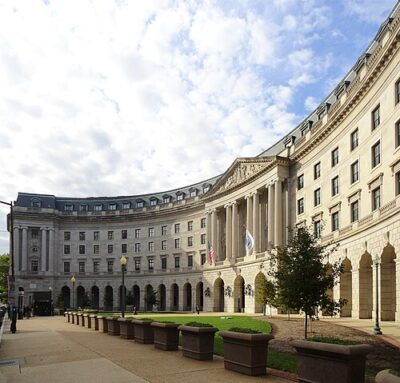
The United States Environmental Protection Agency is an U.S. federal government agency. It was founded in 1970 by Richard Nixon. Its headquarters are in Washington, D.C. It has 14,130 employees (2025).
- Founded
- December 2, 1970
- Founded by
- Richard Nixon
- Headquarters
- Washington, D.C.
- Industry
- environment
- Employees
- 14,130 (2025)
- Country
- United States
All 14 facts, and where they come from
Facts
14 facts · 0 confirmed by two sources · 3 cited · 11 from one source
Where this comes from
Papalocal keeps its own record. It started from these sources; what each one said is kept here as it was copied, so a change on their side never changes this page by itself. Tap one to read its version.
What Wikidata says · copied November 17, 2026 · revision 2564281606
- Described as
- U.S. federal government agency
- Other names
- Environmental Protection Agency, EPA, US EPA, U.S. Environmental Protection Agency, USEPA, U.S. EPA
- What it is
- independent agency of the United States government · 1 reference; publishing house · 1 reference
- Founded
- December 2, 1970 · 1 reference
- Founded by
- Richard Nixon · 1 reference
- Headquarters
- Washington, D.C.
- Country
- United States · 2 references
- Industry
- environment
- Chair
- Lee Zeldin (2025–) · 1 reference
- Employees
- 15,376 (2016) · 2 references
- Part of
- Federal Government of the United States · 1 reference
- Field
- environmental protection · 1 reference; regulation
- Office of
- Federal Government of the United States
- Official website
- https://epa.gov/ · 1 reference
- Wikipedias with a page
- 43
Wikidata item Q460173 (wikidata.org/wiki/Q460173), public domain (CC0). Copied 2026-11-17.
What Wikipedia says · copied November 17, 2026 · revision 1385294375
The Environmental Protection Agency (EPA) is an independent agency of the United States government tasked with environmental protection matters. President Richard Nixon proposed the establishment of EPA on July 9, 1970; it began operation on December 2, 1970, after Nixon signed an executive order. The order establishing the EPA was sent to the House and Senate in accordance with the Reorganization Act of 1949, in which they had 60 days to pass a disapproval resolution or the order would take effect. Congress did not pass a disapproval resolution, and the order establishing the EPA went into effect.
The agency is led by its administrator, who is appointed by the president and approved by the Senate. Since January 29, 2025, the administrator is Lee Zeldin. The EPA is not a Cabinet department, but the administrator is normally given cabinet rank. The EPA has its headquarters in Washington, D.C. There are regional offices for each of the agency's ten regions, as well as 27 laboratories around the country.
The agency conducts environmental assessment, research, and education. It has the responsibility of maintaining and enforcing national standards under a variety of U.S. environmental laws, in consultation with state, tribal, and local governments. EPA enforcement powers include fines, sanctions, and other measures.
It delegates some permitting, monitoring, and enforcement responsibility to U.S. states and the federally recognized tribes. The agency also works with industries and all levels of government in a wide variety of voluntary pollution prevention programs and energy conservation efforts.
The agency's budgeted employee level in 2023 was 16,204.1 full-time equivalent (FTE). More than half of EPA's employees are engineers, scientists, and environmental protection specialists; other employees include legal, public affairs, financial, and information technologists.
From the Wikipedia article “United States Environmental Protection Agency” (en.wikipedia.org/wiki/United_States_Environmental_Protection_Agency), by its contributors, under CC BY-SA 4.0 (creativecommons.org/licenses/by-sa/4.0/). Copied 2026-11-17; not changed.
Confirmed Two sources agree. Cited One source, and it names where it got it. One source One source, without a reference of its own. Sources disagree The sources disagree. We show the best-supported value and keep theirs below.
Picture: Moreau1, via Wikimedia Commons · Public domain