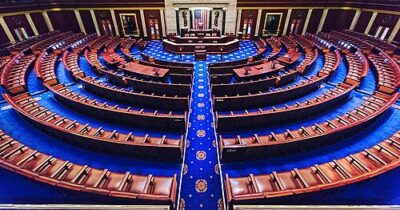
United States House of Representatives
The United States House of Representatives is a lower house of the United States Congress. It was founded in 1789. Its headquarters are in the United States Capitol.
- Founded
- April 1, 1789
- Headquarters
- United States Capitol
- Country
- United States
All 11 facts, and where they come from
Facts
11 facts · 0 confirmed by two sources · 3 cited · 8 from one source
Where this comes from
Papalocal keeps its own record. It started from these sources; what each one said is kept here as it was copied, so a change on their side never changes this page by itself. Tap one to read its version.
What Wikidata says · copied November 17, 2026 · revision 2569299028
- Described as
- lower house of the United States Congress
- Other names
- House of Representatives of the United States, US House of Representatives, U.S. House, House, US HOR, USHOR, HOR, house.gov, U.S. House of Representatives, United States Congress House
- What it is
- house of representatives; elected legislative house; jurisdiction
- Founded
- April 1, 1789 · 1 reference
- Headquarters
- United States Capitol · 1 reference
- Located in
- Washington, D.C. · 2 references
- Country
- United States · 2 references
- Chair
- Nancy Pelosi (2019–2023) · 1 reference; Kevin McCarthy (2023) · 1 reference
- Office of
- United States
- Official website
- https://house.gov
- Wikipedias with a page
- 101
Wikidata item Q11701 (wikidata.org/wiki/Q11701), public domain (CC0). Copied 2026-11-17.
What Wikipedia says · copied November 17, 2026 · revision 1384326030
The United States House of Representatives is a chamber of the bicameral United States Congress; it is the lower house, with the United States Senate being the upper house. Together, the House and Senate have the authority under Article One of the Constitution of the United States in enumerated matters to pass or defeat federal legislation, known as bills. Those that are also passed by the Senate are sent to the president for signature or veto. The House's exclusive powers include initiating all revenue bills, impeaching federal officers, and electing the president if no candidate receives a majority of votes in the Electoral College.
Members of the House serve a fixed term of two years, with each seat up for election before the start of the next Congress. Special elections may occur in the case of a vacancy. The House's composition was established by Article One of the United States Constitution. The House is composed of representatives who, pursuant to the Uniform Congressional District Act, sit in single member congressional districts allocated to each state on the basis of population as measured by the United States census, provided that each state gets at least one representative. Since its inception in 1789, all representatives have been directly elected. Although suffrage was initially limited, it gradually widened, particularly after the ratification of the Nineteenth Amendment and the civil rights movement.
Since 1913, the number of voting representatives has been at 435—with the exception of 1959 to 1963, when it was temporarily increased to 437 following the admissions of Alaska and Hawaii to the Union—pursuant to the Apportionment Act of 1911. The Reapportionment Act of 1929 capped the number of voting members of the House at 435.
Five non-voting delegates represent the District of Columbia and the U.S. territories of Guam, the U.S. Virgin Islands, the Commonwealth of the Northern Mariana Islands, and American Samoa. A non-voting resident commissioner, serving a four-year term, represents the Commonwealth of Puerto Rico. As of the 2020 census, the largest delegation was California, with 52 representatives. Six states have only one representative apiece: Alaska, Delaware, North Dakota, South Dakota, Vermont, and Wyoming.
The House meets in the south wing of the United States Capitol. The rules of the House generally address a two-party system, with a majority party in government, and a minority party in opposition. The presiding officer is the speaker of the House, who is elected by the members thereof. Other floor leaders are chosen by the Democratic Caucus or the Republican Conference, depending on whichever party has more voting members.
From the Wikipedia article “United States House of Representatives” (en.wikipedia.org/wiki/United_States_House_of_Representatives), by its contributors, under CC BY-SA 4.0 (creativecommons.org/licenses/by-sa/4.0/). Copied 2026-11-17; not changed.
Confirmed Two sources agree. Cited One source, and it names where it got it. One source One source, without a reference of its own. Sources disagree The sources disagree. We show the best-supported value and keep theirs below.
Picture: United States House of Representatives or Office of the Speaker of the House, via Wikimedia Commons · Public domain