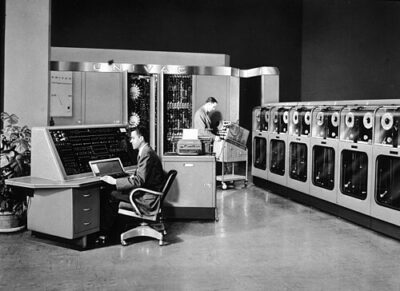
UNIVAC
UNIVAC is a series of mainframe computer models. It was founded in 1946.
- Founded
- 1946
All 2 facts, and where they come from
Facts
2 facts · 0 confirmed by two sources · 0 cited · 2 from one source
Where this comes from
Papalocal keeps its own record. It started from these sources; what each one said is kept here as it was copied, so a change on their side never changes this page by itself. Tap one to read its version.
What Wikidata says · copied November 17, 2026 · revision 2548581922
- Described as
- series of mainframe computer models
- Other names
- Statistical EDVAC
- What it is
- computer model series
- Founded
- 1946
- Wikipedias with a page
- 25
Wikidata item Q1443793 (wikidata.org/wiki/Q1443793), public domain (CC0). Copied 2026-11-17.
What Wikipedia says · copied November 17, 2026 · revision 1386025240
UNIVAC (Universal Automatic Computer) was a line of electronic digital stored-program computers starting with the products of the Eckert–Mauchly Computer Corporation. After capturing the public imagination with the use of the UNIVAC I during the 1952 US Presidential election, it was decided to extend the branding to all machines made by the other computing divisions of the Remington Rand company (Engineering Research Associates and the Norwalk Laboratory of Remington Rand).
After the merger of Remington Rand with the Sperry Corporation (under name of Sperry Rand) in 1955, it was decided to merge all three divisions along with Remington Rand's tabulator division into one unified organization under the name of the Univac division. This name persisted until the mid-1980s when it was renamed to the Sperry Computer Systems Division; the last UNIVAC-badged system was the UNIVAC 1100/90, which was announced in 1982 and first shipped in late 1983.
From the Wikipedia article “UNIVAC” (en.wikipedia.org/wiki/UNIVAC), by its contributors, under CC BY-SA 4.0 (creativecommons.org/licenses/by-sa/4.0/). Copied 2026-11-17; not changed.
Confirmed Two sources agree. Cited One source, and it names where it got it. One source One source, without a reference of its own. Sources disagree The sources disagree. We show the best-supported value and keep theirs below.
Picture: U.S. Census Bureau employees, via Wikimedia Commons · Public domain