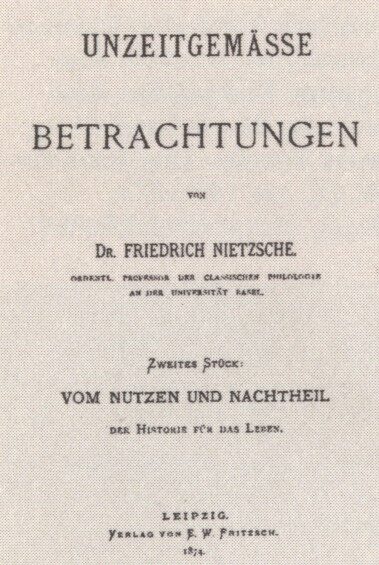
Untimely Meditations
Untimely Meditations is an essay by Friedrich Nietzsche. It came out in 1873.
- Released
- 1873
- Written by
- Friedrich Nietzsche
- Genre
- essay
All 7 facts, and where they come from
Facts
7 facts · 0 confirmed by two sources · 0 cited · 7 from one source
Where this comes from
Papalocal keeps its own record. It started from these sources; what each one said is kept here as it was copied, so a change on their side never changes this page by itself. Tap one to read its version.
What Wikidata says · copied November 17, 2026 · revision 2569524551
- Described as
- essay by Friedrich Nietzsche
- What it is
- book series
- Written by
- Friedrich Nietzsche
- Genre
- essay
- Released
- 1873
- Language
- German · 1 reference
- Comes after
- The Birth of Tragedy
- Followed by
- Human, All Too Human
- Wikipedias with a page
- 19
Wikidata item Q1605652 (wikidata.org/wiki/Q1605652), public domain (CC0). Copied 2026-11-17.
What Wikipedia says · copied November 17, 2026 · revision 1384888002
Untimely Meditations (German: Unzeitgemässe Betrachtungen), also translated as Unfashionable Observations and Thoughts Out of Season, consists of four works by the philosopher Friedrich Nietzsche, which he started writing in 1873, and completed in 1876.
The work consists of a collection of four (out of a projected 13) essays concerning the contemporary condition of European, especially German, culture. A fifth essay, published posthumously, had the title "We Philologists", and gave as a "task of philology: to disappear". Nietzsche here began to discuss the limitations of empirical knowledge, and presented what would appear compressed in later aphorisms. It combines the naivete of The Birth of Tragedy with the beginnings of his more mature polemical style. It was Nietzsche's most humorous work, especially for the essay "David Strauss: the Confessor and the Writer."
From the Wikipedia article “Untimely Meditations” (en.wikipedia.org/wiki/Untimely_Meditations), by its contributors, under CC BY-SA 4.0 (creativecommons.org/licenses/by-sa/4.0/). Copied 2026-11-17; not changed.
Confirmed Two sources agree. Cited One source, and it names where it got it. One source One source, without a reference of its own. Sources disagree The sources disagree. We show the best-supported value and keep theirs below.
Picture: Wikimedia Commons · Public domain