URL
URL is a web address to a particular file or page. It was made by the Internet Engineering Task Force and Web Hypertext Application Technology Working Group.
- Made by
- Internet Engineering Task Force
All 4 facts, and where they come from
Facts
4 facts · 0 confirmed by two sources · 1 cited · 3 from one source
Where this comes from
Papalocal keeps its own record. It started from these sources; what each one said is kept here as it was copied, so a change on their side never changes this page by itself. Tap one to read its version.
What Wikidata says · copied November 17, 2026 · revision 2556443750
- Described as
- web address to a particular file or page
- Other names
- Universal Resource Locator, web address, Uniform Resource Locators, u.r.l., Uniform Resource Locator, internet address, URL address
- What it is
- technical standard
- Made by
- Internet Engineering Task Force; Web Hypertext Application Technology Working Group
- Official website
- https://url.spec.whatwg.org/ · 1 reference
- Wikipedias with a page
- 100
Wikidata item Q42253 (wikidata.org/wiki/Q42253), public domain (CC0). Copied 2026-11-17.
What Wikipedia says · copied November 17, 2026 · revision 1379420948
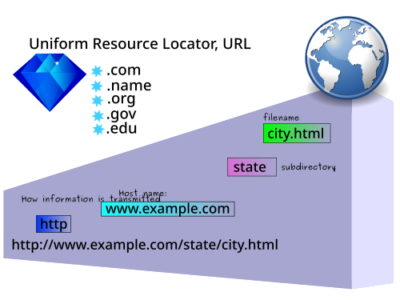
A uniform resource locator (URL), colloquially known as a web address, is a reference to a resource on the World Wide Web. A URL specifies the location of a resource on a computer network and a mechanism for retrieving it. A URL is a specific type of Uniform Resource Identifier (URI), although many people use the two terms interchangeably. A URL is most commonly used to reference a web page (HTTP/HTTPS) but is also used for file transfer (FTP), email (mailto), database access (JDBC), and many other applications.
Most web browsers display the URL of a web page above the page in an address bar. As an example of a web page URL, https://www.example.com/index.html indicates protocol https, hostname www.example.com, and file name index.html.
From the Wikipedia article “URL” (en.wikipedia.org/wiki/URL), by its contributors, under CC BY-SA 4.0 (creativecommons.org/licenses/by-sa/4.0/). Copied 2026-11-17; not changed.
Confirmed Two sources agree. Cited One source, and it names where it got it. One source One source, without a reference of its own. Sources disagree The sources disagree. We show the best-supported value and keep theirs below.
Picture: Jimmy Olano, via Wikimedia Commons · CC BY-SA 3.0