Viète's formula
Viète's formula is an infinite product converging to the inverse of π.
All 1 facts, and where they come from
Facts
1 facts · 0 confirmed by two sources · 0 cited · 1 from one source
Where this comes from
Papalocal keeps its own record. It started from these sources; what each one said is kept here as it was copied, so a change on their side never changes this page by itself. Tap one to read its version.
What Wikidata says · copied November 17, 2026 · revision 2522355567
- Described as
- infinite product converging to the inverse of π
- What it is
- formula
- Wikipedias with a page
- 17
Wikidata item Q949597 (wikidata.org/wiki/Q949597), public domain (CC0). Copied 2026-11-17.
What Wikipedia says · copied November 17, 2026 · revision 1368655711
In mathematics, Viète's formula is the following infinite product of nested radicals representing twice the reciprocal of the mathematical constant π:
2π=22⋅2+22⋅2+2+22⋯=12⋅12+1212⋅12+1212+1212⋯
It can also be represented as
2π=∏n=1∞cosπ2n+1.
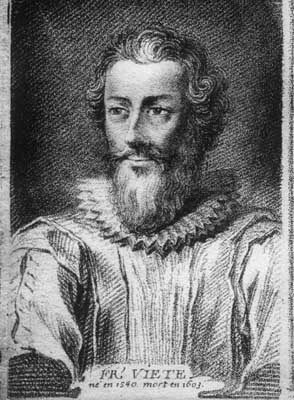
The formula is named after François Viète, who published it in 1593. As the first formula of European mathematics to represent an infinite process, it can be given a rigorous meaning as a limit expression and marks the beginning of mathematical analysis. It has linear convergence and can be used for calculations of π, but other methods before and since have led to greater accuracy. It has also been used in calculations of the behavior of systems of springs and masses and as a motivating example for the concept of statistical independence.
The formula can be derived as a telescoping product of either the areas or perimeters of nested polygons converging to a circle. Alternatively, repeated use of the half-angle formula from trigonometry leads to a generalized formula, discovered by Leonhard Euler, that has Viète's formula as a special case. Many similar formulas involving nested roots or infinite products are now known.
From the Wikipedia article “Viète's formula” (en.wikipedia.org/wiki/Viète's_formula), by its contributors, under CC BY-SA 4.0 (creativecommons.org/licenses/by-sa/4.0/). Copied 2026-11-17; not changed.
Confirmed Two sources agree. Cited One source, and it names where it got it. One source One source, without a reference of its own. Sources disagree The sources disagree. We show the best-supported value and keep theirs below.