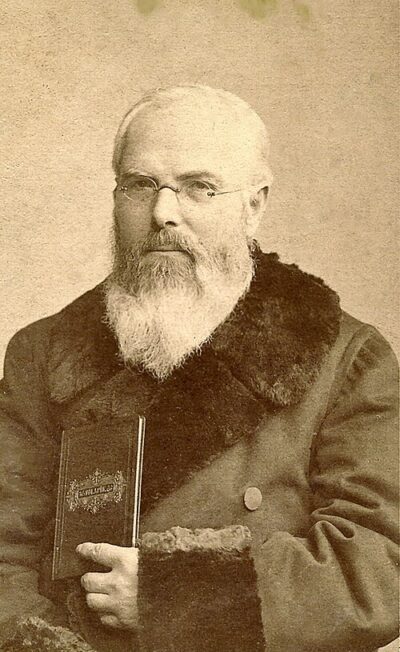
Volapük
Volapük is a constructed international auxiliary language. It came out in 1931. It was created by Johann Martin Schleyer.
- Released
- 1931
- Came out
- 1880
- Created by
- Johann Martin Schleyer
All 8 facts, and where they come from
Facts
8 facts · 0 confirmed by two sources · 2 cited · 5 from one source · 1 where the sources disagree
What’s different
- Came out: we show 1880 (Sources disagree). Wikidata also lists 1879
Where this comes from
Papalocal keeps its own record. It started from these sources; what each one said is kept here as it was copied, so a change on their side never changes this page by itself. Tap one to read its version.
What Wikidata says · copied November 17, 2026 · revision 2570418896
- Described as
- constructed international auxiliary language
- Other names
- Volapuk, Volapük nulik, vo
- What it is
- constructed language · 2 references; international auxiliary language; planned language · 1 reference
- Created by
- Johann Martin Schleyer · 1 reference
- Released
- 1931
- Came out
- 1879; 1880 · 1 reference
- Country
- Germany
- Official website
- https://volapük.com
- Wikipedias with a page
- 120
Wikidata item Q36986 (wikidata.org/wiki/Q36986), public domain (CC0). Copied 2026-11-17.
What Wikipedia says · copied November 17, 2026 · revision 1383298512
Volapük (English: ; Volapük: [volaˈpyk], 'Language of the World', or lit. 'World Speak') is a constructed language created in 1879 and 1880 by Johann Martin Schleyer, a Roman Catholic priest in Baden, Germany. Notable as the first major constructed international auxiliary language, it primarily drew from Germanic languages. Its grammar is inspired largely by German, although it was heavily regularized by Schleyer, while its lexicon is rooted mostly in English, with additional influence from German, the Romance languages, and Russian. Despite some roots remaining recognizable, many words were altered beyond recognition, as Schleyer sought to make most of the vocabulary monosyllabic.
Volapük conventions took place in 1884 (Friedrichshafen), 1887 (Munich) and 1889 (Paris). The first two conventions used German, and the last conference used only Volapük. By 1889, there were an estimated 283 clubs, 25 periodicals in or about Volapük, and 316 textbooks in 25 languages; at that time the language claimed nearly a million adherents. Volapük experienced a small revival in the 1930s due to Arie de Jong's reforms of the language, which became called Volapük nulik. This form simplified the language and became the commonly accepted form of it. Volapük was largely displaced between the late 19th and early 20th century by Esperanto, as many Volapükists switched to Esperanto due to the internal conflicts within the Volapükist movement.
Volapük still maintains a small userbase to this day, and it has seen a small revival in the 21st century.
From the Wikipedia article “Volapük” (en.wikipedia.org/wiki/Volapük), by its contributors, under CC BY-SA 4.0 (creativecommons.org/licenses/by-sa/4.0/). Copied 2026-11-17; not changed.
Confirmed Two sources agree. Cited One source, and it names where it got it. One source One source, without a reference of its own. Sources disagree The sources disagree. We show the best-supported value and keep theirs below.
Picture: Wikimedia Commons: Volapükahüm.png · See Commons file page