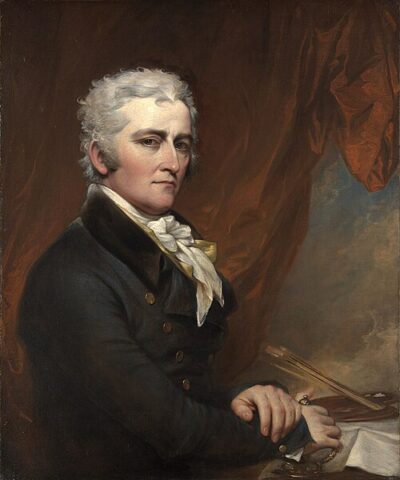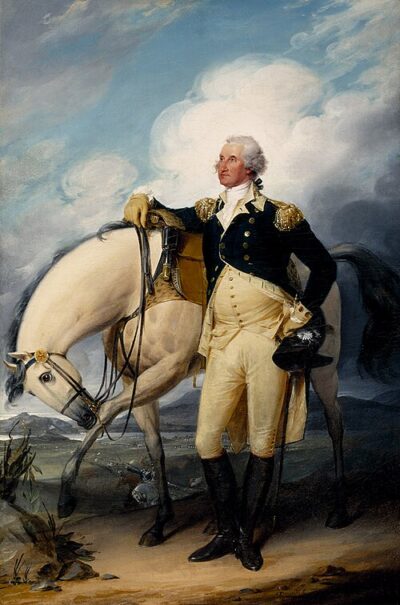
Washington at Verplanck's Point
Washington at Verplanck's Point is a painting by John Trumbull. It came out in 1790.
- Came out
- 1790
- Created by
- John Trumbull
- Genre
- portrait
All 4 facts, and where they come from
Facts
4 facts · 0 confirmed by two sources · 0 cited · 4 from one source
Where this comes from
Papalocal keeps its own record. It started from these sources; what each one said is kept here as it was copied, so a change on their side never changes this page by itself. Tap one to read its version.
What Wikidata says · copied November 17, 2026 · revision 2557482437
- Described as
- painting by John Trumbull
- What it is
- painting
- Created by
- John Trumbull
- Genre
- portrait
- Came out
- 1790
- Wikipedias with a page
- 3
Wikidata item Q29052300 (wikidata.org/wiki/Q29052300), public domain (CC0). Copied 2026-11-17.
What Wikipedia says · copied November 17, 2026 · revision 1364432242
Washington at Verplanck's Point is a full-length portrait in oil painted in 1790 by the American artist John Trumbull of General George Washington at Verplanck's Point on the North River in New York during the American Revolutionary War. The background depicts the September 14, 1782 review of Continental Army troops Washington staged there as an honor for the departing French commander Comte de Rochambeau and his army.
The painting was a gift from Trumbull to the president's wife, Martha Washington, and is now owned by the Winterthur Museum. Trumbull next received a commission from the City of New York and painted a much larger version, George Washington, with a new background, Evacuation Day of New York City, November 25, 1783, the return of Washington and the departure of British forces. It is on display in the Governor's Room of New York City Hall.
From the Wikipedia article “Washington at Verplanck's Point” (en.wikipedia.org/wiki/Washington_at_Verplanck's_Point), by its contributors, under CC BY-SA 4.0 (creativecommons.org/licenses/by-sa/4.0/). Copied 2026-11-17; not changed.
Confirmed Two sources agree. Cited One source, and it names where it got it. One source One source, without a reference of its own. Sources disagree The sources disagree. We show the best-supported value and keep theirs below.
Picture: John Trumbull, via Wikimedia Commons · Public domain