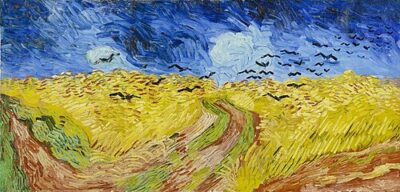
Wheatfield with Crows
Wheatfield with Crows is a painting by Vincent van Gogh. It came out in 1890.
- Came out
- July 1890
- Created by
- Vincent van Gogh
- Genre
- landscape painting
All 5 facts, and where they come from
Facts
5 facts · 0 confirmed by two sources · 4 cited · 1 from one source
Where this comes from
Papalocal keeps its own record. It started from these sources; what each one said is kept here as it was copied, so a change on their side never changes this page by itself. Tap one to read its version.
What Wikidata says · copied November 17, 2026 · revision 2567403162
- Described as
- painting by Vincent van Gogh
- What it is
- painting · 1 reference
- Created by
- Vincent van Gogh · 1 reference
- Genre
- landscape painting
- Came out
- July 1890 · 1 reference
- Country
- Netherlands · 1 reference
- Wikipedias with a page
- 43
Wikidata item Q634122 (wikidata.org/wiki/Q634122), public domain (CC0). Copied 2026-11-17.
What Wikipedia says · copied November 17, 2026 · revision 1379190324
Wheatfield with Crows (Dutch: Korenveld met kraaien) is a July 1890 painting by Vincent van Gogh. It has been cited by several critics as one of his greatest works.
It is commonly stated that this was Van Gogh's final painting. This association was popularized by Vincente Minnelli’s 1956 biopic Lust for Life, which depicts Van Gogh painting it immediately before shooting himself. His final painting in actuality was Tree Roots. The evidence of his letters suggests that Wheatfield with Crows was completed around 10 July and predates such paintings as Auvers Town Hall on 14 July 1890 and Daubigny's Garden. Moreover, Jan Hulsker has written that a painting of harvested wheat, Field with Stacks of Wheat (F771), must be a later painting.
From the Wikipedia article “Wheatfield with Crows” (en.wikipedia.org/wiki/Wheatfield_with_Crows), by its contributors, under CC BY-SA 4.0 (creativecommons.org/licenses/by-sa/4.0/). Copied 2026-11-17; not changed.
Confirmed Two sources agree. Cited One source, and it names where it got it. One source One source, without a reference of its own. Sources disagree The sources disagree. We show the best-supported value and keep theirs below.
Picture: Vincent van Gogh, via Wikimedia Commons · Public domain