witch of Agnesi
Witch of Agnesi is a mathematical curve.
All 5 facts, and where they come from
Facts
5 facts · 0 confirmed by two sources · 0 cited · 5 from one source
Where this comes from
Papalocal keeps its own record. It started from these sources; what each one said is kept here as it was copied, so a change on their side never changes this page by itself. Tap one to read its version.
What Wikidata says · copied November 17, 2026 · revision 2540965374
- Described as
- mathematical curve
- Other names
- witch of Maria Agnesi, versoria, versiera, The Witch of Agnesi, versicra, witch of Maria Gaetana Agnesi
- What it is
- curve; cubic plane curve; mathematical concept
- Named after
- Maria Gaetana Agnesi; versine
- Wikipedias with a page
- 27
Wikidata item Q517269 (wikidata.org/wiki/Q517269), public domain (CC0). Copied 2026-11-17.
What Wikipedia says · copied November 17, 2026 · revision 1384823542
In mathematics, the witch of Agnesi (Italian pronunciation: [aɲˈɲeːzi, -eːsi; -ɛːzi]) is a cubic plane curve defined from two diametrically opposite points of a circle.
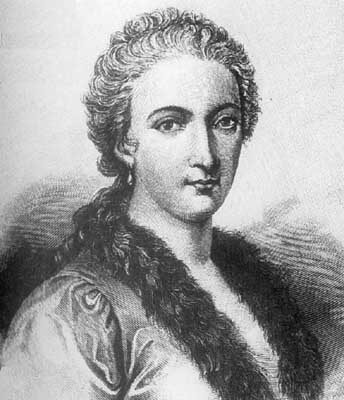
The curve was studied as early as 1653 by Pierre de Fermat, in 1703 by Guido Grandi, and by Isaac Newton. It gets its name from Italian mathematician Maria Gaetana Agnesi who published it in 1748. The Italian name la versiera di Agnesi is based on Latin versoria (sheet of sailing ships) and the sinus versus.
This was read by John Colson as l'avversiera di Agnesi, where avversiera is translated as "woman who is against God" and interpreted as "witch".
The graph of the derivative of the arctangent function forms an example of the witch of Agnesi. As the probability density function of the Cauchy distribution, the witch of Agnesi has applications in probability theory. It also gives rise to Runge's phenomenon in the approximation of functions by polynomials, has been used to approximate the energy distribution of spectral lines, and models the shape of hills.
The witch is tangent to its defining circle at one of the two defining points, and asymptotic to the tangent line to the circle at the other point. It has a unique vertex (a point of extreme curvature) at the point of tangency with its defining circle, which is also its osculating circle at that point. It also has two finite inflection points and one infinite inflection point. The area between the witch and its asymptotic line is four times the area of the defining circle, and the volume of revolution of the curve around its defining line is twice the volume of the torus of revolution of its defining circle.
From the Wikipedia article “Witch of Agnesi” (en.wikipedia.org/wiki/Witch_of_Agnesi), by its contributors, under CC BY-SA 4.0 (creativecommons.org/licenses/by-sa/4.0/). Copied 2026-11-17; not changed.
Confirmed Two sources agree. Cited One source, and it names where it got it. One source One source, without a reference of its own. Sources disagree The sources disagree. We show the best-supported value and keep theirs below.
Picture: Wikimedia Commons: Agnesi.gif · See Commons file page