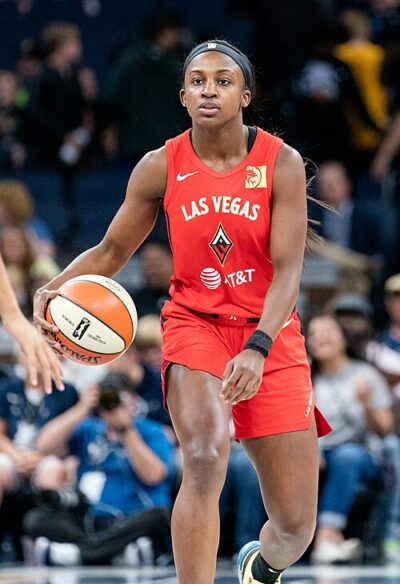
WNBA Most Improved Player Award
WNBA Most Improved Player Award is a sports award. It was created in 2000.
- Country
- United States
- Created
- 2000
All 4 facts, and where they come from
Facts
4 facts · 0 confirmed by two sources · 0 cited · 4 from one source
Where this comes from
Papalocal keeps its own record. It started from these sources; what each one said is kept here as it was copied, so a change on their side never changes this page by itself. Tap one to read its version.
What Wikidata says · copied November 17, 2026 · revision 2520133611
- Described as
- award
- What it is
- sports award
- Created
- 2000
- Country
- United States
- Sport
- basketball
- Wikipedias with a page
- 10
Wikidata item Q278827 (wikidata.org/wiki/Q278827), public domain (CC0). Copied 2026-11-17.
What Wikipedia says · copied November 17, 2026 · revision 1377818598
The Women's National Basketball Association's Most Improved Player Award is an annual Women's National Basketball Association (WNBA) award given since the 2000 WNBA season, to the most improved player of the regular season. The winner is selected by a panel of sportswriters throughout the United States, each of whom casts a vote for first, second, and third place selections. Each first-place vote is worth five points; each second-place vote is worth three points; and each third-place vote is worth one point. The player with the highest point total, regardless of the number of first-place votes, wins the award.
In 2019, Leilani Mitchell became the first player in history to win the award twice, after winning the award in 2010. In 2004, there was a tie—both Kelly Miller and Wendy Palmer received the award. Nicole Powell, Natasha Howard, and Jackie Young are the only players to win the Most Improved award and a WNBA title in the same year.
From the Wikipedia article “WNBA Most Improved Player” (en.wikipedia.org/wiki/WNBA_Most_Improved_Player), by its contributors, under CC BY-SA 4.0 (creativecommons.org/licenses/by-sa/4.0/). Copied 2026-11-17; not changed.
Confirmed Two sources agree. Cited One source, and it names where it got it. One source One source, without a reference of its own. Sources disagree The sources disagree. We show the best-supported value and keep theirs below.