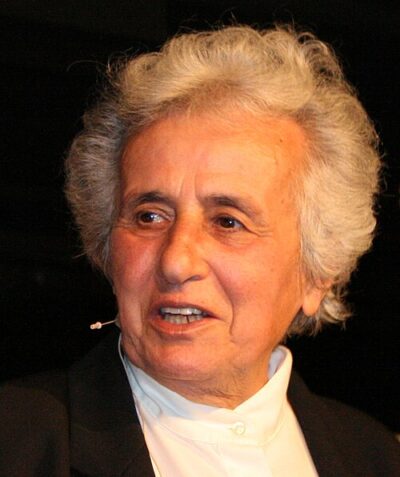
Women's Orchestra of Auschwitz
Women's Orchestra of Auschwitz is a female orchestra at Auschwitz concentration camp. It was founded in 1943.
- Founded
- 1943
- Country
- Poland
All 6 facts, and where they come from
Facts
6 facts · 0 confirmed by two sources · 0 cited · 6 from one source
Where this comes from
Papalocal keeps its own record. It started from these sources; what each one said is kept here as it was copied, so a change on their side never changes this page by itself. Tap one to read its version.
What Wikidata says · copied November 18, 2026 · revision 2552835192
- Described as
- female orchestra at Auschwitz concentration camp
- Other names
- Girls' Orchestra of Auschwitz
- What it is
- Orchestras of Prisoners in Nazi Camps; Damenkapelle; all-female orchestra
- Founded
- 1943
- Ended
- 1944
- Country
- Poland
- Wikipedias with a page
- 15
Wikidata item Q317540 (wikidata.org/wiki/Q317540), public domain (CC0). Copied 2026-11-18.
What Wikipedia says · copied November 18, 2026 · revision 1382044265
The Women's Orchestra of Auschwitz (Mädchenorchester von Auschwitz; lit. "Girls' Orchestra of Auschwitz") was formed by order of the SS in 1943, during the Holocaust, in the Auschwitz II-Birkenau extermination camp in German-occupied Poland. Active for 18 months—from April 1943 until October 1944—the orchestra consisted of mostly young female Jewish and Slavic prisoners, of varying nationalities, who would rehearse for up to ten hours a day to play music regarded as helpful in the daily running of the camp. They also held a concert every Sunday for the SS.
A member of the orchestra, Fania Fénelon, published her experiences as an autobiography, Sursis pour l'orchestre (1976), which appeared in English as Playing for Time (1977). The book was the basis of a television film of the same name in 1980, written by Arthur Miller.
From the Wikipedia article “Women's Orchestra of Auschwitz” (en.wikipedia.org/wiki/Women's_Orchestra_of_Auschwitz), by its contributors, under CC BY-SA 4.0 (creativecommons.org/licenses/by-sa/4.0/). Copied 2026-11-18; not changed.
Confirmed Two sources agree. Cited One source, and it names where it got it. One source One source, without a reference of its own. Sources disagree The sources disagree. We show the best-supported value and keep theirs below.