

Wound Badge
Wound Badge is a wound decorations in the German military in World War I and World War II in black, silver and gold. It was created in 1918.
- Country
- German Reich
- Created
- March 3, 1918
All 5 facts, and where they come from
Facts
5 facts · 0 confirmed by two sources · 0 cited · 4 from one source · 1 where the sources disagree
What’s different
- Created: we show March 3, 1918 (Sources disagree). Wikidata also lists June 24, 1918 and May 22, 1939
Where this comes from
Papalocal keeps its own record. It started from these sources; what each one said is kept here as it was copied, so a change on their side never changes this page by itself. Tap one to read its version.
What Wikidata says · copied November 17, 2026 · revision 2532680875
- Described as
- wound decorations in the German military in World War I and World War II in black, silver and gold
- What it is
- breast badge; wound decoration; group of awards
- Created
- March 3, 1918 · 1 reference; June 24, 1918 · 1 reference; May 22, 1939 · 1 reference
- Country
- German Reich
- Wikipedias with a page
- 32
Wikidata item Q680248 (wikidata.org/wiki/Q680248), public domain (CC0). Copied 2026-11-17.
What Wikipedia says · copied November 17, 2026 · revision 1386189460
The Wound Badge (German: Verwundetenabzeichen) was a German military decoration first promulgated by Wilhelm II, German Emperor on 3 March 1918, which was first awarded to soldiers of the German Army who were wounded during World War I. Between the world wars, it was awarded to members of the German armed forces who fought on the Nationalist side of the Spanish Civil War, 1938–39, and received combat-related wounds. In September 1939, Adolf Hitler reinstated the award, with the major change being the helmet. The style of the helmet was changed from the one used in World War I to the 1935 pattern helmet. During World War II, it was awarded to members in the Wehrmacht, Schutzstaffel (SS) and the auxiliary service organizations. After March 1943, due to the increasing number of Allied bombings, it was also awarded to civilians wounded in air raids. It was awarded when the wound was the result of enemy hostile action. In 1957, the West German government authorized a denazified (Swastika removed) version of the basic (black, silver, and gold) badges for wear on the Bundeswehr uniform, among other certain Nazi-era wartime awards.
From the Wikipedia article “Wound Badge” (en.wikipedia.org/wiki/Wound_Badge), by its contributors, under CC BY-SA 4.0 (creativecommons.org/licenses/by-sa/4.0/). Copied 2026-11-17; not changed.
Confirmed Two sources agree. Cited One source, and it names where it got it. One source One source, without a reference of its own. Sources disagree The sources disagree. We show the best-supported value and keep theirs below.
Picture: Wikimedia Commons: VWA Schwarz WK1.jpg · See Commons file page
People connected 4
Won it
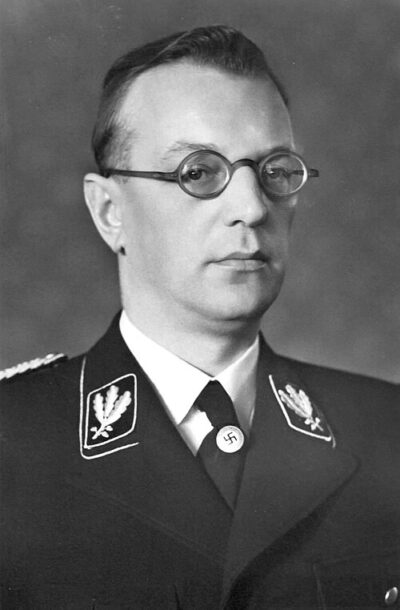 Arthur Seyss-InquartAustrian Nazi politician, and Nazi ruler of occupied Netherlands, convicted of crimes against humanity and sentenced to death (1892–1946)
 Erich von dem Bach-ZelewskiGerman politician and SS functionary (1899–1972)
 Hans AlbersGerman actor (1891-1960)
 Walter NowotnyAustrian born German officer and fighter pilot during World War II (1920–1944)
