
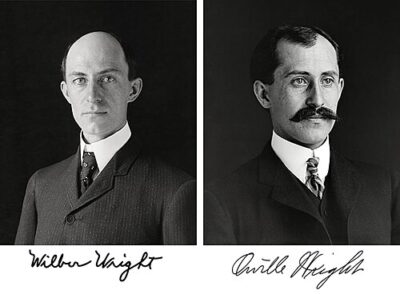
Wright brothers
Wright brothers is an American aviation pioneers. It won the Congressional Gold Medal and 3 more.
- Industry
- aerospace industry
All 7 facts, and where they come from
Facts
7 facts · 0 confirmed by two sources · 3 cited · 4 from one source
Where this comes from
Papalocal keeps its own record. It started from these sources; what each one said is kept here as it was copied, so a change on their side never changes this page by itself. Tap one to read its version.
What Wikidata says · copied November 17, 2026 · revision 2564157088
- Described as
- American aviation pioneers
- Other names
- Orville and Wilbur Wright
- What it is
- team · 1 reference; brother duo
- Industry
- aerospace industry
- Awards
- Congressional Gold Medal · 1 reference; National Aviation Hall of Fame · 1 reference; Washington Award (1927) · 1 reference; Franklin Medal · 1 reference
- Wikipedias with a page
- 120
Wikidata item Q35820 (wikidata.org/wiki/Q35820), public domain (CC0). Copied 2026-11-17.
What Wikipedia says · copied November 17, 2026 · revision 1385333340
The Wright brothers, Orville Wright (August 19, 1871 – January 30, 1948) and Wilbur Wright (April 16, 1867 – May 30, 1912), were American aviation pioneers who researched, invented, built, and flew the world's first successful airplane. They made the first controlled, sustained flight of an engine-powered, heavier-than-air aircraft with the Wright Flyer on December 17, 1903, four miles (6 km) south of Kitty Hawk, North Carolina, at what is now known as Kill Devil Hills. In 1904 the Wright brothers developed the Wright Flyer II, which made longer-duration flights including the first circle, followed in 1905 by the first truly practical fixed-wing aircraft, the Wright Flyer III.
The brothers' breakthrough invention was their creation of a three-axis control system, which enabled the pilot to steer the aircraft effectively and to maintain its equilibrium. Their system of aircraft controls made fixed-wing powered flight possible and remains standard on airplanes of all kinds. Their first U.S. patent, written in March 1903, before their first flight at Kitty Hawk, did not claim invention of a flying machine, but rather a system of aerodynamic control that manipulated a flying machine's surfaces. From the beginning of their aeronautical work, Wilbur and Orville focused on developing a reliable method of pilot control as the key to solving "the flying problem". This approach differed significantly from other experimenters of the time who put more emphasis on developing powerful engines. Using a small home-built wind tunnel, the Wrights also collected more accurate data than any before, enabling them to design more efficient wings and propellers.
The brothers gained the mechanical skills essential to their success by working for years in their Dayton, Ohio-based shop with printing presses, bicycles, motors, and other machinery. Their work with bicycles, in particular, influenced their belief that an unstable vehicle such as a flying machine could be controlled and balanced with practice. This was a trend, as many other aviation pioneers were also dedicated cyclists and involved in the bicycle business in various ways. From 1900 until their first powered flights in late 1903, the brothers conducted extensive glider tests that also developed their skills as pilots. Their shop mechanic Charles Taylor became an important part of the team, building their first airplane engine in close collaboration with the brothers.
From the Wikipedia article “Wright brothers” (en.wikipedia.org/wiki/Wright_brothers), by its contributors, under CC BY-SA 4.0 (creativecommons.org/licenses/by-sa/4.0/). Copied 2026-11-17; not changed.
Confirmed Two sources agree. Cited One source, and it names where it got it. One source One source, without a reference of its own. Sources disagree The sources disagree. We show the best-supported value and keep theirs below.
Picture: Orville Wright and Wilbur Wright (credited as photographers) [1], [2], [3], via Wikimedia Commons · Public domain
