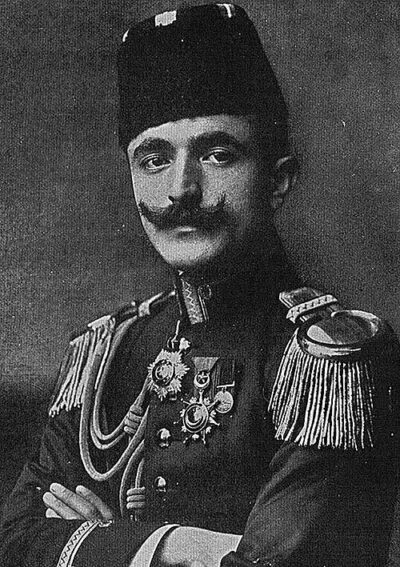
Young Turks
Young Turks is a political reform movement in the Ottoman Empire. It stands for constitutionalism and reformism.
- Country
- Ottoman Empire
All 4 facts, and where they come from
Facts
4 facts · 0 confirmed by two sources · 0 cited · 4 from one source
Where this comes from
Papalocal keeps its own record. It started from these sources; what each one said is kept here as it was copied, so a change on their side never changes this page by itself. Tap one to read its version.
What Wikidata says · copied November 17, 2026 · revision 2517094027
- Described as
- political reform movement in the Ottoman Empire
- What it is
- political movement
- Country
- Ottoman Empire · 1 reference
- Ideology
- constitutionalism; reformism
- Wikipedias with a page
- 61
Wikidata item Q83896 (wikidata.org/wiki/Q83896), public domain (CC0). Copied 2026-11-17.
What Wikipedia says · copied November 17, 2026 · revision 1379977265
The Young Turks (Ottoman Turkish: ژون تركلر, romanized: Jön Türkler, also كنج تركلر Genç Türkler) were a broad opposition movement in the late Ottoman Empire to the absolutist régime of Sultan Abdul Hamid II (r. 1876–1909). The prominent organisation within the movement was the Committee of Union and Progress (CUP, founded in 1889), though its ideology, strategies, and membership continuously changed. By the 1890s, the Young Turks were mainly a loose and contentious network of exiled intelligentsia who made a living by selling their newspapers to secret subscribers. Beyond opposition, exiled writers and sociologists debated Turkey's place in the East–West dichotomy.
By and large, Young Turks favored taking power away from Yıldız Palace in favour of constitutional governance, though the movement itself held a mosaic of ideologies. Besides membership in outlawed political committees, other avenues of opposition existed in the ulama, Sufi lodges, and Masonic lodges. The movement was popular especially among young, educated Ottomans and military officers that wanted reforms. They believed that a social contract in the form of a constitution would fix the empire's problems with nationalist movements and foreign intervention by instilling Ottomanism, or multi-cultural Ottoman nationalism.
The Unionists, or members of the CUP, prevailed against Sultan Abdul Hamid II in the 1908 Young Turk Revolution. With this revolution, the Young Turks helped to inaugurate the Second Constitutional Era in the same year, ushering in an era of multi-party democracy for the first time in the country's history. In power, the CUP implemented many secularizing and centralizing reforms, but was criticized for pursuing a pro–Turkish ideology. In the wake of events which proved disastrous for the Ottoman Empire as a body-politic (such as the 31 March Incident of April 1909, the 1912 coup, and the Balkan Wars of 1912–1913), the country fell under the domination of a radicalized CUP following the 1913 Raid on the Sublime Porte.
With the strength of the constitution and of parliament broken, the CUP ruled the Ottoman Empire in a dictatorship, and orchestrated the entrance of the empire into World War I in October 1914 on the side of the Central Powers. The genocides of 1915 to 1917 against Ottoman Christians were masterminded within the CUP, principally by Talat Pasha, Enver Pasha, Bahaeddin Şakir, and others.
The term Young Turk is now used to characterize an insurgent impatiently advocating reform within an organization, and various groups in different countries have been designated "Young Turks" because of their rebellious or revolutionary nature.
From the Wikipedia article “Young Turks” (en.wikipedia.org/wiki/Young_Turks), by its contributors, under CC BY-SA 4.0 (creativecommons.org/licenses/by-sa/4.0/). Copied 2026-11-17; not changed.
Confirmed Two sources agree. Cited One source, and it names where it got it. One source One source, without a reference of its own. Sources disagree The sources disagree. We show the best-supported value and keep theirs below.
Picture: Wikimedia Commons: Jon-turkler-1.jpg · See Commons file page