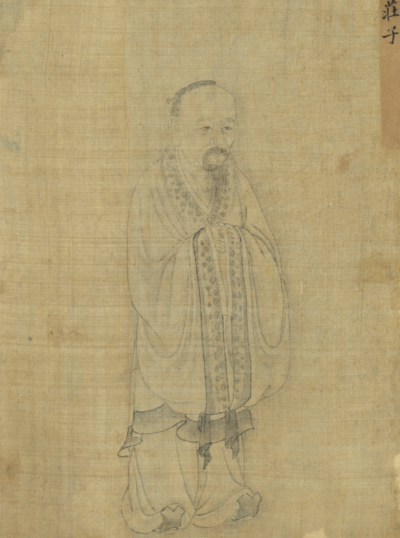
Zhuangzi
Zhuangzi is an ancient Chinese Taoist text from the Warring States period traditionally attributed to Zhuang Zhou.
- Came out
- 300s BC
- Written by
- Zhuang Zhou
- Genre
- Taoist literature
- Country of origin
- Eastern Zhou
All 7 facts, and where they come from
Facts
7 facts · 0 confirmed by two sources · 0 cited · 7 from one source
Where this comes from
Papalocal keeps its own record. It started from these sources; what each one said is kept here as it was copied, so a change on their side never changes this page by itself. Tap one to read its version.
What Wikidata says · copied November 17, 2026 · revision 2555910902
- Described as
- ancient Chinese Taoist text from the Warring States period traditionally attributed to Zhuang Zhou
- Other names
- True Scripture of Southern Florescence, Nanhua zhenjing, Chuang Tzu, Chuang Tzŭ, Nánhuá zhēnjīng, Nan hua zhen jing, DZ 670
- What it is
- written work; literary work
- Written by
- Zhuang Zhou
- Genre
- Taoist literature
- Language
- Classical Chinese
- Country of origin
- Eastern Zhou · 1 reference
- Came out
- 300s BC
- Wikipedias with a page
- 39
Wikidata item Q1074987 (wikidata.org/wiki/Q1074987), public domain (CC0). Copied 2026-11-17.
What Wikipedia says · copied November 17, 2026 · revision 1384317934
The Zhuangzi (historically romanized Chuang Tzŭ) is an ancient Chinese text that is one of the two foundational texts of Taoism, alongside the Tao Te Ching. It was written during the late Warring States period (476–221 BC) and is named for its traditional author, Zhuang Zhou, who is customarily known as "Zhuangzi" ("Master Zhuang").
The Zhuangzi consists of stories and maxims that exemplify the nature of the ideal Taoist sage. It recounts many anecdotes, allegories, parables, and fables, often expressed with irreverence or humor. Recurring themes include embracing spontaneity and achieving freedom from the human world and its conventions. The text aims to illustrate the arbitrariness and ultimate falsity of dichotomies normally embraced by human societies, such as those between good and bad, large and small, life and death, or human and nature. In contrast with the focus on good morals and personal duty expressed by many Chinese philosophers of the period, Zhuang Zhou promoted carefree wandering and following nature, through which one would ultimately become one with the "Way" (Tao).
Though appreciation for the work often focuses on its philosophy, the Zhuangzi is also regarded as one of the greatest works of literature in the Classical Chinese canon. It has significantly influenced major Chinese writers and poets across more than two millennia, with the first attested commentary on the work written during the Han dynasty (202 BC – 220 AD). It has been called "the most important pre-Qin text for the study of Chinese literature".
From the Wikipedia article “Zhuangzi (book)” (en.wikipedia.org/wiki/Zhuangzi_(book)), by its contributors, under CC BY-SA 4.0 (creativecommons.org/licenses/by-sa/4.0/). Copied 2026-11-17; not changed.
Confirmed Two sources agree. Cited One source, and it names where it got it. One source One source, without a reference of its own. Sources disagree The sources disagree. We show the best-supported value and keep theirs below.
Picture: Wikimedia Commons: Zhuangzi Tian Yun Ms.JPG · See Commons file page