
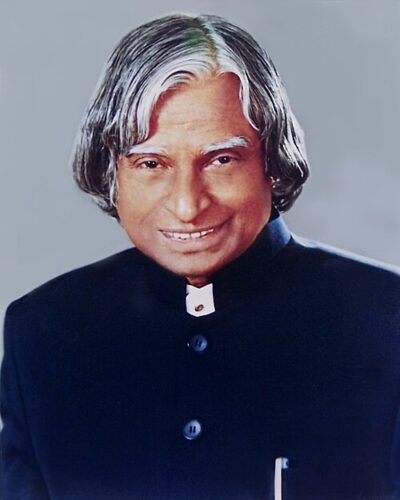
A. P. J. Abdul Kalam
A. P. J. Abdul Kalam was an Indian scientist, president and statesman. Born October 15, 1931, in Rameswaram. Died July 27, 2015, in Shillong. Positions held include President of India (2002–2007) and president. Known for Wings of Fire. Educated at St Joseph's College, Tiruchirappalli and University of Madras. Awards include Padma Bhushan, Bharat Ratna and H K Firodia awards.
Facts
36 facts · 2 confirmed by two sources · 21 cited · 13 from one source
Where this comes from
Papalocal keeps its own record. It started from these sources; what each one said is kept here as it was copied, so a change on their side never changes this page by itself. Tap one to read its version.
What Wikidata says · copied November 16, 2026 · revision 2567341390
- Described as
- Indian scientist, president and statesman (1931–2015)
- Other names
- Abdul Kalam, Kalam, A.P.J Abdul Kalam, A P J Abdul Kalam, Abul Pakiz Jainulabdeen Abdul Kalam, APJ Abdul Kalam, Dr APJ Abdul Kalam, APJ, Avul Pakir Jainulabdeen Abdul Kalam
- Born
- October 15, 1931 · 6 references
- Died
- July 27, 2015 · 7 references
- Born in
- Rameswaram · 1 reference
- Died in
- Shillong · 1 reference
- Cause of death
- cardiac arrest · 1 reference
- Citizen of
- India (1950–) · 1 reference; Dominion of India (1947–1950)
- Occupation
- politician · 2 references; military flight engineer · 1 reference; engineer · 1 reference; teacher; aerospace engineer · 1 reference
- Positions held
- President of India (2002–2007) · 1 reference; president · 1 reference
- Education
- St Joseph's College, Tiruchirappalli; University of Madras · 1 reference; Oakland University
- Known for
- Wings of Fire · 1 reference
- Awards
- Padma Bhushan (1981) · 1 reference; Bharat Ratna (1997) · 1 reference; H K Firodia awards (1996); Padma Vibhushan in Science & Engineering (1990) · 1 reference; Om Prakash Bhasin Award (1986); Hoover Medal (2008); King Charles II Medal (2007); NSS Wernher Von Braun Memorial Award (2013); Padma Vibhushan · 1 reference
- Field
- aerospace engineering · 1 reference; aerospace manufacturer · 1 reference; poetry · 1 reference; politics · 1 reference; science · 1 reference; aerospace industry · 1 reference
- Religion
- Sunni Islam; Islam · 1 reference
- Website
- http://www.abdulkalam.nic.in/profile.html
- Wikipedias with a page
- 102
Wikidata item Q9513 (wikidata.org/wiki/Q9513), public domain (CC0). Copied November 16, 2026.
What Wikipedia says · copied November 16, 2026 · revision 1383600514
Avul Pakir Jainulabdeen Abdul Kalam ( UB-duul kə-LAHM; 15 October 1931 – 27 July 2015) was an Indian aerospace engineer and science administrator who served as president of India from 2002 to 2007. In 1997, he was awarded India's highest civilian honour, the Bharat Ratna, for his contribution to the scientific research and modernisation of defence technology in India.
Born and raised in a Muslim family in Rameswaram, Tamil Nadu, Kalam studied physics and aerospace engineering. He spent the next four decades as a scientist and science administrator, mainly at the Defence Research and Development Organisation (DRDO) and Indian Space Research Organisation (ISRO) and was intimately involved in India's civilian space programme and military missile development efforts. He is popularly known as the "Missile Man of India" for his work on the development of ballistic missile and launch vehicle technology. He also played a pivotal organisational, technical, and political role in Pokhran-II nuclear tests in 1998, India's second such test after the first test in 1974.
Kalam was elected as the president of India in 2002 with the support of both the ruling Bharatiya Janata Party and the then-opposition Indian National Congress. He was widely referred to as the "People's President". He engaged in teaching, writing and public service after his presidency. While delivering a lecture at IIM Shillong, Kalam collapsed and died from an apparent cardiac arrest on 27 July 2015, aged 83. Thousands attended the funeral ceremony held in his hometown of Rameswaram, where he was buried with full state honours. A memorial was inaugurated near his home town in 2017.
- Born, in its opening lines
- October 15, 1931
- Died, in its opening lines
- July 27, 2015
From the Wikipedia article “A. P. J. Abdul Kalam” (en.wikipedia.org/wiki/A._P._J._Abdul_Kalam), by its contributors, under CC BY-SA 4.0 (creativecommons.org/licenses/by-sa/4.0/). Copied November 16, 2026; not changed.
Confirmed Two sources agree. Cited One source, and it names where it got it. One source One source, without a reference of its own. Sources disagree The sources disagree. We show the best-supported value and keep theirs below.
