
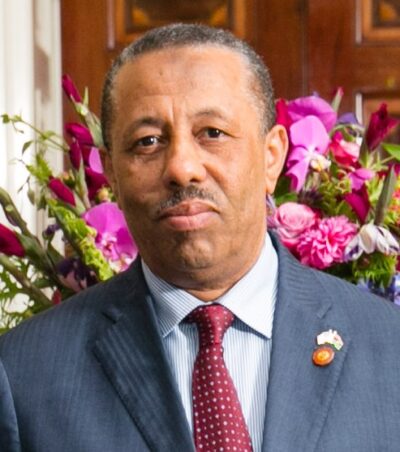
Abdullah al-Thani
Abdullah al-Thani is a Libyan politician. Born January 7, 1954, in Kano. Positions held include Prime Minister of Libya (2014–2021) and Minister of Defence (2013–2014). Educated at Benghazi Military University Academy.
Facts
9 facts · 0 confirmed by two sources · 0 cited · 9 from one source
Where this comes from
Papalocal keeps its own record. It started from these sources; what each one said is kept here as it was copied, so a change on their side never changes this page by itself. Tap one to read its version.
What Wikidata says · copied November 18, 2026 · revision 2562808564
- Described as
- Libyan politician
- Other names
- Abdullah Thani
- Born
- January 7, 1954
- Born in
- Kano
- Citizen of
- Libya
- Occupation
- politician
- Positions held
- Prime Minister of Libya (2014–2021); Minister of Defence (2013–2014)
- Political party
- independent politician · 1 reference
- Education
- Benghazi Military University Academy
- Religion
- Islam
- Wikipedias with a page
- 22
Wikidata item Q15925685 (wikidata.org/wiki/Q15925685), public domain (CC0). Copied November 18, 2026.
What Wikipedia says · copied November 18, 2026 · revision 1378253851
Abdullah al-Theni (Arabic: عبد الله الثني Libyan pronunciation: [ʕæbˈdɑllɑ tˈtini, -ˈθæni]) is a Libyan politician who served as the prime minister of Libya, from 2014, when he took over in an interim capacity after the dismissal of Ali Zeidan, to 2021. In the context of the second Libyan civil war, he served as prime minister under the Tobruk-based government. His government received widespread international recognition until 2016 as well as backing from both the Libyan House of Representatives and the Libyan National Army. He was previously the defence minister in the government of Zeidan.
From the Wikipedia article “Abdullah al-Theni” (en.wikipedia.org/wiki/Abdullah_al-Theni), by its contributors, under CC BY-SA 4.0 (creativecommons.org/licenses/by-sa/4.0/). Copied November 18, 2026; not changed.
Confirmed Two sources agree. Cited One source, and it names where it got it. One source One source, without a reference of its own. Sources disagree The sources disagree. We show the best-supported value and keep theirs below.
