
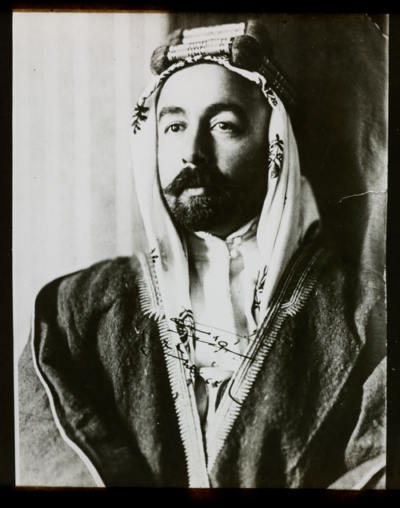
Abdullah I of Jordan
Abdullah I of Jordan was a Ruler of Transjordan and Jordan from 1921 to 1951. Born February 2, 1882, in Mecca. Died July 20, 1951, in Masjid Al-Aqsa. Positions held include King of Jordan (1946–1951). Awards include Knight Grand Cross of the Order of the British Empire, Knight Grand Cross of the Order of St Michael and St George and Grand Cross of the Cross of Military Merit with White Decoration.
Facts
34 facts · 2 confirmed by two sources · 5 cited · 27 from one source
What’s different
- Born: we show February 2, 1882 (Confirmed). Wikidata also lists 1882
- Died: we show July 20, 1951 (Confirmed). Wikidata also lists 1951
Where this comes from
Papalocal keeps its own record. It started from these sources; what each one said is kept here as it was copied, so a change on their side never changes this page by itself. Tap one to read its version.
What Wikidata says · copied November 16, 2026 · revision 2567428856
- Described as
- Ruler of Transjordan and Jordan from 1921 to 1951
- Other names
- King Abdullah I, King Abdullah, 'Abdallah I
- Born
- February 2, 1882 · 1 reference; 1882 · 2 references
- Died
- July 20, 1951 · 6 references; 1951 · 1 reference
- Born in
- Mecca · 1 reference
- Died in
- Masjid Al-Aqsa
- Buried in
- Raghadan Palace
- Cause of death
- gunshot wound
- Citizen of
- Ottoman Empire; Kingdom of Hejaz; Emirate of Transjordan; Jordan
- Occupation
- monarch; Amir · 1 reference; king · 1 reference
- Positions held
- King of Jordan (1946–1951)
- Awards
- Knight Grand Cross of the Order of the British Empire; Knight Grand Cross of the Order of St Michael and St George; Grand Cross of the Cross of Military Merit with White Decoration; Order of Pahlavi; King George VI Coronation Medal; Grand Order of the Hashimites; Order of the Two Rivers; Order of the Umayyads; Order of Muhammad Ali
- Spouse
- Musbah bint Nasser
- Children
- Talal I of Jordan · 1 reference; Naif bin Abdullah
- Father
- Hussein bin Ali
- Mother
- Abdiya bint Abdullah · 1 reference
- Siblings
- Faisal I of Iraq; Ali of Hejaz; Prince Zeid bin Hussein
- Religion
- Sunni Islam; Islam
- Military rank
- field marshal
- Wikipedias with a page
- 71
Wikidata item Q192780 (wikidata.org/wiki/Q192780), public domain (CC0). Copied November 16, 2026.
What Wikipedia says · copied November 16, 2026 · revision 1381758816
Abdullah I (né Abdullah bin Hussein al-Hashimi; 2 February 1882 – 20 July 1951) was the ruler of Jordan from 11 April 1921 until his assassination in 1951. He was the Emir of Transjordan, a British protectorate, until 25 May 1946, after which he was king of an independent Jordan. As a member of the Hashemite dynasty, the royal family of Jordan since 1921, Abdullah was a 38th-generation direct descendant of Muhammad.
Born in Mecca, Hejaz, Ottoman Empire, Abdullah was the second of four sons of Hussein bin Ali, Sharif of Mecca, and his first wife, Abdiyya bint Abdullah. He was educated in Istanbul and Hejaz. From 1909 to 1914, Abdullah sat in the Ottoman legislature, as deputy for Mecca, but allied with Britain during the First World War. During the war, he played a key role in secret negotiations with the United Kingdom that led to the Arab Revolt against Ottoman rule that was led by his father Sharif Hussein. Abdullah personally led guerrilla raids on garrisons.
Abdullah became Emir of Transjordan in April 1921. He upheld his alliance with the British during World War II, and became king after Transjordan gained independence from the United Kingdom in 1946. In 1950, Jordan annexed the West Bank, which angered Arab countries including Syria, Saudi Arabia and Egypt. He was assassinated in Jerusalem while attending Friday prayers at the entrance of the Al-Aqsa Mosque by a Palestinian in 1951. Abdullah was succeeded by his eldest son Talal.
- Born, in its opening lines
- February 2, 1882
- Died, in its opening lines
- July 20, 1951
From the Wikipedia article “Abdullah I of Jordan” (en.wikipedia.org/wiki/Abdullah_I_of_Jordan), by its contributors, under CC BY-SA 4.0 (creativecommons.org/licenses/by-sa/4.0/). Copied November 16, 2026; not changed.
Confirmed Two sources agree. Cited One source, and it names where it got it. One source One source, without a reference of its own. Sources disagree The sources disagree. We show the best-supported value and keep theirs below.
