
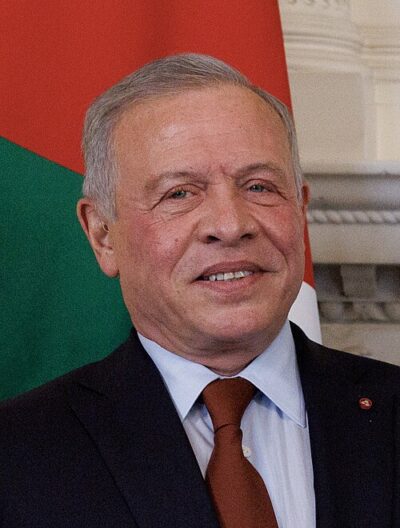
Abdullah II of Jordan
Abdullah II of Jordan is a King of the Hashemite Kingdom of Jordan. Born January 30, 1962, in Amman. Positions held include heir apparent (2 times) (1962–1999), Custodian of the Holy Sites of Jerusalem and King of Jordan (1999–). Educated at Royal Military Academy Sandhurst and Walsh School of Foreign Service. Awards include Knight Grand Cross of the Order of the Bath, Knight Commander of the Royal Victorian Order and Grand Cross of the Order of Isabella the Catholic.
Facts
54 facts · 1 confirmed by two sources · 4 cited · 49 from one source
Where this comes from
Papalocal keeps its own record. It started from these sources; what each one said is kept here as it was copied, so a change on their side never changes this page by itself. Tap one to read its version.
What Wikidata says · copied November 16, 2026 · revision 2567428718
- Described as
- King of the Hashemite Kingdom of Jordan
- Other names
- King Abdullah II, King Abdullah, Abdullah ibn al-Hussein, King Abdullah II of Jordan is, H.M. King Abdullah II Ibn Al Hussein, Abdullah II Ibn Al Hussein, H.M. King Abdullah II bin Al Hussein, His Majesty Abdullah II Ibn Al Hussein, His Majesty Abdullah II Bin Al Hussein, H.M. King Abdullah II Ibn Hussein of the Hashemite Kingdom of Jordan, Abdullah II ibn al-Hussein, Abdullah II
- Born
- January 30, 1962 · 8 references
- Born in
- Amman · 2 references
- Citizen of
- Jordan
- Occupation
- politician; writer · 1 reference; military officer; monarch
- Positions held
- heir apparent (2 times) (1962–1999); Custodian of the Holy Sites of Jerusalem; King of Jordan (1999–)
- Education
- Royal Military Academy Sandhurst; Walsh School of Foreign Service; Deerfield Academy; Pembroke College; St Edmund's School; Eaglebrook School
- Member of
- Abdullah II of Jordan and Queen Rania
- Awards
- Knight Grand Cross of the Order of the Bath; Knight Commander of the Royal Victorian Order; Grand Cross of the Order of Isabella the Catholic; Collar of the Order of Isabella the Catholic (1999) · 1 reference; Knight Grand Cross of the Order of St Michael and St George; Grand cross of the Order of the White Lion (2015) · 2 references; Grand Cross Special Class of the Order of Merit of the Federal Republic of Germany (2002); Collar of the Order of the Star of Romania; Order of the White Eagle; Award of the Peace of Westphalia (2016) · 1 reference; Golden Plate Award; Order of Freedom of the Republic of Slovenia; Order of Merit, 1st class · 1 reference; Grand Order of Mugunghwa; Collar of the Order of Charles III
- Spouse
- Queen Rania of Jordan (1993–)
- Children
- Hussein bin Abdullah, Crown Prince of Jordan; Princess Iman bint Abdullah of Jordan; Princess Salma bint Abdullah of Jordan; Prince Hashem bin Abdullah of Jordan
- Father
- Hussein I of Jordan · 1 reference
- Mother
- Princess Muna Al-Hussein
- Siblings
- Princess Alia bint Al-Hussein of Jordan; Prince Feisal bin Al-Hussein of Jordan; Princess Aisha bint Al-Hussein of Jordan; Princess Zein bint Al-Hussein of Jordan; Princess Haya bint Al-Hussein of Jordan; Prince Ali bin Al-Hussein of Jordan; Princess Abir Muhaisen; Hamzah bin Al-Hussein; Prince Hashem bin Al-Hussein of Jordan; Princess Iman bint Al-Hussein of Jordan
- Religion
- Islam
- Military branch
- Jordanian Armed Forces
- Military rank
- field marshal
- Lived in
- Raghadan Palace · 1 reference
- Website
- http://www.kingabdullah.jo
- Wikipedias with a page
- 112
Wikidata item Q57464 (wikidata.org/wiki/Q57464), public domain (CC0). Copied November 16, 2026.
What Wikipedia says · copied November 16, 2026 · revision 1385030266
Abdullah II (Abdullah bin Hussein; born 30 January 1962) is the king of Jordan, having acceded to the throne on 7 February 1999. He is a member of the Hashemites, who have been the reigning royal family of Jordan since 1921, and is traditionally regarded as a 41st-generation direct descendant of the Islamic prophet Muhammad.
Abdullah was born in Amman, as the first child of King Hussein and his wife, Princess Muna. As the king's eldest son, Abdullah was heir apparent until Hussein transferred the title to Abdullah's uncle Prince Hassan in 1965. Abdullah began his schooling in Amman, continuing his education abroad. He began his military career in 1980 as a training officer in the Jordanian Armed Forces, later assuming command of the country's Special Forces in 1994, eventually becoming a major general in 1998. In 1993, Abdullah married Rania Al-Yassin, with whom he has four children: Crown Prince Hussein, Princess Iman, Princess Salma and Prince Hashem. A few weeks before his death in 1999, King Hussein named Abdullah his heir, and Abdullah succeeded his father.
Abdullah, a constitutional monarch, heads an authoritarian regime with wide executive and legislative powers. He liberalized the economy when he assumed the throne. In 2011, large-scale protests demanding reform erupted in the Arab world, which led to civil wars in some countries. Abdullah responded quickly to domestic unrest by replacing the government and introducing reforms. Proportional representation was reintroduced to the Jordanian parliament for the 2016 election, a move which he said would eventually lead to establishing a parliamentary government, but government critics remain skeptical, viewing the reforms as cosmetic changes. Power remains centralized in the king's hands. The reforms took place amid unprecedented challenges stemming from regional instability, including an influx of 1.4 million Syrian refugees.
Abdullah is known for promoting interfaith dialogue and a moderate understanding of Islam. The longest-serving current Arab leader, he is custodian of the Muslim and Christian religious sites in Jerusalem, a position held by his dynasty since 1924. The 2021 Pandora Papers revealed Abdullah's hidden wealth through offshore entities.
- Born, in its opening lines
- January 30, 1962
From the Wikipedia article “Abdullah II” (en.wikipedia.org/wiki/Abdullah_II), by its contributors, under CC BY-SA 4.0 (creativecommons.org/licenses/by-sa/4.0/). Copied November 16, 2026; not changed.
Confirmed Two sources agree. Cited One source, and it names where it got it. One source One source, without a reference of its own. Sources disagree The sources disagree. We show the best-supported value and keep theirs below.
