
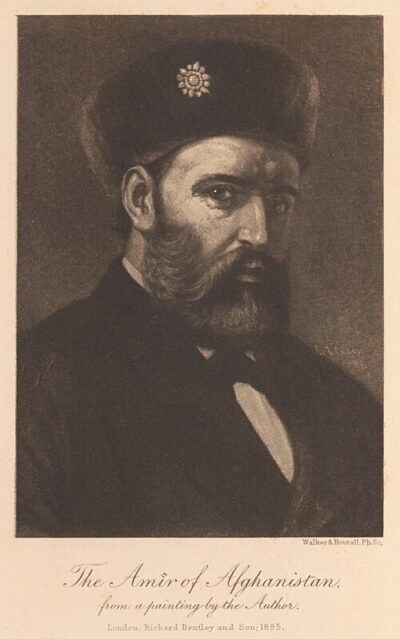
Abdur Rahman Khan
Abdur Rahman Khan was an Emir of Afghanistan from 1880 to 1901. Born 1844, in Kabul. Died October 1, 1901, in Kabul. Positions held include Emir of Afghanistan (1880–1901). Awards include Knight Grand Cross of the Order of the Bath.
Facts
14 facts · 0 confirmed by two sources · 3 cited · 8 from one source · 3 where the sources disagree
What’s different
- Born: we show 1844 (Sources disagree). Wikidata also lists 1840
- Born in: we show Kabul (Sources disagree). Wikidata also lists Emirate of Afghanistan
- Died in: we show Kabul (Sources disagree). Wikidata also lists Emirate of Afghanistan
Where this comes from
Papalocal keeps its own record. It started from these sources; what each one said is kept here as it was copied, so a change on their side never changes this page by itself. Tap one to read its version.
What Wikidata says · copied November 16, 2026 · revision 2568061568
- Described as
- Emir of Afghanistan from 1880 to 1901
- Other names
- Abdur-Rahman, Amir 'Abd al-Rahman Khan
- Born
- 1840; 1844 · 2 references
- Died
- October 1, 1901
- Born in
- Kabul · 1 reference; Emirate of Afghanistan
- Died in
- Kabul · 1 reference; Emirate of Afghanistan
- Buried in
- mausoleum of Abdur Rahman Khan
- Citizen of
- Afghanistan
- Occupation
- politician; Amir · 1 reference
- Positions held
- Emir of Afghanistan (1880–1901)
- Awards
- Knight Grand Cross of the Order of the Bath
- Children
- Nasrullah Khan; Habibullah Khan · 1 reference
- Father
- Mohammad Afzal Khan · 1 reference
- Religion
- Sunni Islam
- Wikipedias with a page
- 54
Wikidata item Q31649 (wikidata.org/wiki/Q31649), public domain (CC0). Copied November 16, 2026.
What Wikipedia says · copied November 16, 2026 · revision 1382244005
Abdur Rahman Khan Barakzai (1840/1844 – 1 October 1901), also known by his epithet as the Iron Emir, was Emir of Afghanistan from 11 August 1880 until his death on 1 October 1901. He is known for uniting the country after years of strong decentralization and internal fighting, and for the negotiation of the Durand Line agreement with British India.
Abdur Rahman Khan was the only son of Mohammad Afzal Khan, and grandson of Dost Mohammad Khan, founder of the Barakzai dynasty. Abdur Rahman Khan re-established the writ of the Afghan government after the disarray that followed the Second Anglo-Afghan war. He became known as The Iron Emir because of his government's military despotism. This despotism rested upon a well-appointed army and was administered through officials subservient to an inflexible will and controlled by a widespread system of espionage.
The nickname, The Iron Amir, is also associated due to his victory over a number of rebellions by various tribes who were led by his relatives. One source says that during his reign there were over 40 rebellions against his rule. Abdur Rahman Khan's rule was termed by one British official as a "reign of terror", as he was considered despotic and had up to 100,000 people judicially executed during his 21 years as Emir. Thousands more starved to death, caught deadly diseases and died, were massacred by his army, or were killed during his forceful migrations of tribes. However, scholars such as Jonathan Lee note that he was perhaps one of the most skilled military leaders from Afghanistan.
From the Wikipedia article “Abdur Rahman Khan” (en.wikipedia.org/wiki/Abdur_Rahman_Khan), by its contributors, under CC BY-SA 4.0 (creativecommons.org/licenses/by-sa/4.0/). Copied November 16, 2026; not changed.
Confirmed Two sources agree. Cited One source, and it names where it got it. One source One source, without a reference of its own. Sources disagree The sources disagree. We show the best-supported value and keep theirs below.
