
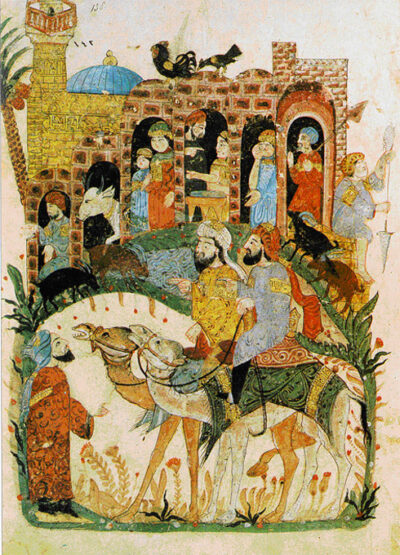
Abu al-Hariri was an Arab poet and scholar. Born 1054, in Basra. Died September 10, 1122, in Basra. Known for Maqamat of al-Hariri.
Facts
17 facts · 2 confirmed by two sources · 10 cited · 5 from one source
Where this comes from
Papalocal keeps its own record. It started from these sources; what each one said is kept here as it was copied, so a change on their side never changes this page by itself. Tap one to read its version.
What Wikidata says · copied November 16, 2026 · revision 2567223046
- Described as
- Arab poet and scholar (1054–1122)
- Other names
- Al-Hariri, al-Hariri of Basra, Muhammad al-Qasim Al-Hariri, Abū Muhammad al-Qāsim ibn Alī ibn Muhammad ibn Uthmān al-Harīrī, Hariri
- Born
- 1054 · 16 references
- Died
- September 10, 1122 · 1 reference
- Born in
- Basra
- Died in
- Basra
- Occupation
- poet · 1 reference; writer · 1 reference; arabist · 1 reference; literary scholar · 1 reference; grammarian · 1 reference; historian · 1 reference
- Genre
- maqāma
- Known for
- Maqamat of al-Hariri
- Field
- Arabic studies · 1 reference; poetry · 1 reference; Arabic poetry · 1 reference; Arabic literature · 1 reference
- Religion
- Islam
- Wikipedias with a page
- 31
Wikidata item Q286097 (wikidata.org/wiki/Q286097), public domain (CC0). Copied November 16, 2026.
What Wikipedia says · copied November 16, 2026 · revision 1385459162
Al-Hariri of Basra (Arabic: أبو محمد القاسم بن علي بن محمد بن عثمان الحريري, romanized: Abū Muhammad al-Qāsim ibn ʿAlī ibn Muhammad ibn ʿUthmān al-Harīrī; c. 1054 – 10 September 1122) was a poet belonging to the Beni Harram tribe of Bedouin Arabs, who lived and died in the city of Basra, modern Iraq. He was a scholar of the Arabic language and a dignitary of the Seljuk Empire, which ruled Iraq during his lifetime, from 1055 to 1135.
He is known for his Maqamat al-Hariri (also known as the ‘'Assemblies of Hariri'’), a collection of some 50 stories written in the Maqama style, a mix of verse and literary prose. For more than eight centuries, Al-Hariri's best known work, his Maqamat has been regarded as one of the greatest treasure in Arabic literature after the Quran and the Pre-Islamic poetic canons. Although the maqamat did not originate with al-Hariri, he elevated the genre to an art form.
- Born, in its opening lines
- c. 1054
- Died, in its opening lines
- September 10, 1122
From the Wikipedia article “Al-Hariri of Basra” (en.wikipedia.org/wiki/Al-Hariri_of_Basra), by its contributors, under CC BY-SA 4.0 (creativecommons.org/licenses/by-sa/4.0/). Copied November 16, 2026; not changed.
Confirmed Two sources agree. Cited One source, and it names where it got it. One source One source, without a reference of its own. Sources disagree The sources disagree. We show the best-supported value and keep theirs below.
