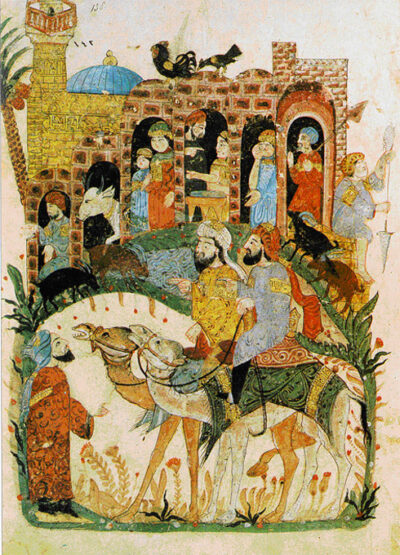
Maqamat of al-Hariri
Maqamat of al-Hariri is a collection of tales from the Middle East. It was written by Abu al-Hariri.
- Written by
- Abu al-Hariri
- Genre
- maqāma
All 4 facts, and where they come from
Facts
4 facts · 0 confirmed by two sources · 0 cited · 4 from one source
Where this comes from
Papalocal keeps its own record. It started from these sources; what each one said is kept here as it was copied, so a change on their side never changes this page by itself. Tap one to read its version.
What Wikidata says · copied November 17, 2026 · revision 2538960389
- Described as
- collection of tales from the Middle East
- Other names
- The Assemblies of Al-Hariri, Fifty Encounters with the Shayck Abu Zayd of Seruj, Impostures
- What it is
- literary work
- Written by
- Abu al-Hariri
- Genre
- maqāma
- Language
- Arabic
- Wikipedias with a page
- 9
Wikidata item Q12244584 (wikidata.org/wiki/Q12244584), public domain (CC0). Copied 2026-11-17.
What Wikipedia says · copied November 17, 2026 · revision 1384486943
The Maqāmāt al-Ḥarīrī (Arabic: مقامات الحريري) is a collection of fifty tales or maqāmāt written at the end of the 11th or the beginning of the 12th century by al-Ḥarīrī of Basra (1054–1122), a poet and government official of the Seljuk Empire. The text presents a series of tales regarding the adventures of the fictional character Abū Zayd of Saruj who travels and deceives those around him with his skill in the Arabic language to earn rewards. Although probably less creative than the work of its precursor, Maqāmāt al-Hamadhānī (whose author lived 968–1008 CE), the Maqāmāt al-Ḥarīrī became extremely popular, with reports of seven hundred copies authorized by al-Ḥarīrī during his lifetime.
The first known manuscripts date from the 13th century, with eight illustrated manuscripts known from this period. The most famous manuscripts include one from 1237 in Baghdad (now in the Bibliothèque Nationale de France) and one from 1334 in Egypt or Syria (now in the National Library of Austria).
Altogether, more than a hundred manuscripts of the work are known, but only thirteen are illustrated. They were mainly produced over a period of about 150 years. A first phase consists in manuscripts created between 1200 and 1256 in areas between Syria and Iraq. This phase is followed by a 50-year gap, corresponding to the Mongol invasions (invasion of Persia and Mesopotamia, with the Siege of Baghdad in 1258, and the invasion of the Levant). A second phase runs from around 1300 to 1337, during the Egyptian Mamluk period, with production probably centered around Cairo.
Manuscripts of the Maqāmāt al-Ḥarīrī belong to the category of "secular Arabic manuscripts", as opposed to religious works such as illustrated Qur'ans.
From the Wikipedia article “Maqamat al-Hariri” (en.wikipedia.org/wiki/Maqamat_al-Hariri), by its contributors, under CC BY-SA 4.0 (creativecommons.org/licenses/by-sa/4.0/). Copied 2026-11-17; not changed.
Confirmed Two sources agree. Cited One source, and it names where it got it. One source One source, without a reference of its own. Sources disagree The sources disagree. We show the best-supported value and keep theirs below.
Picture: Wikimedia Commons: Maqamat of al-Hariri. Enthroned Prince. Probably Egypt 1334.jpg · See Commons file page