
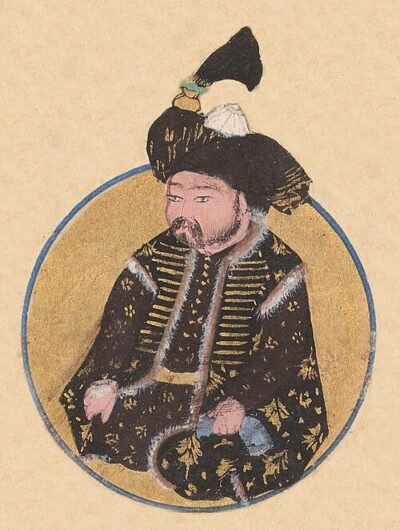
Abu Muslim al Khorasani
Abu Muslim al Khorasani was an Abbasid general. Born 718, in Isfahan. Died February 755, in Seleucia-Ctesiphon. Positions held include vizier and commander-in-chief.
Facts
10 facts · 1 confirmed by two sources · 0 cited · 7 from one source · 2 where the sources disagree
What’s different
- Born: we show 718 (Sources disagree). Wikipedia says 727
- Born in: we show Isfahan (Sources disagree). Wikidata also lists Merv
Where this comes from
Papalocal keeps its own record. It started from these sources; what each one said is kept here as it was copied, so a change on their side never changes this page by itself. Tap one to read its version.
What Wikidata says · copied November 16, 2026 · revision 2564816593
- Described as
- Abbasid general
- Other names
- Abu Muslim Khorasani
- Born
- 718
- Died
- February 755
- Born in
- Isfahan; Merv
- Died in
- Seleucia-Ctesiphon
- Occupation
- military leader; wali; da'i
- Positions held
- vizier; commander-in-chief
- Religion
- Islam
- Wikipedias with a page
- 53
Wikidata item Q335210 (wikidata.org/wiki/Q335210), public domain (CC0). Copied November 16, 2026.
What Wikipedia says · copied November 16, 2026 · revision 1357729314
Abu Muslim (c. 718 to 727 – 755 CE) was a Persian revolutionary and military commander who was a central figure in the Abbasid Revolution that brought down the Umayyad Caliphate and established the Abbasid Caliphate.
Enslaved in Kufa during his youth, he came under the influence of Shi'ite activists associated with the Abbasid family when they secured his release and introduced him to anti-Umayyad doctrines. Recognized for his abilities and loyalty, he was tasked with leading Abbasid revolutionary activities in Khorasan and conferred the nom de guerre Abu Muslim.
In 747, Abu Muslim initiated the open phase of the Abbasid revolt, rapidly seizing Merv and rallying broad support among the populations of Khorasan. He subsequently directed the Abbasid advance across the Iranian plateau and into the Levant, culminating in the collapse of Umayyad authority and the proclamation of the Abbasid Caliphate. Thereafter he served as governor of Khorasan and emerged as one of the most powerful figures of the early Abbasid state.
Abu Muslim’s growing prominence provoked concern within the Abbasid leadership. While the first caliph refrained from acting against him, the second caliph, al-Mansur, ordered his execution in 755, alleging — likely without basis — that he harbored crypto-Zoroastrian sympathies. His death provoked unrest across Greater Iran, where he was subsequently venerated as a quasi-religious figure and martyr for centuries.
- Born, in its opening lines
- 727
- Died, in its opening lines
- 755
From the Wikipedia article “Abu Muslim” (en.wikipedia.org/wiki/Abu_Muslim), by its contributors, under CC BY-SA 4.0 (creativecommons.org/licenses/by-sa/4.0/). Copied November 16, 2026; not changed.
Confirmed Two sources agree. Cited One source, and it names where it got it. One source One source, without a reference of its own. Sources disagree The sources disagree. We show the best-supported value and keep theirs below.
