
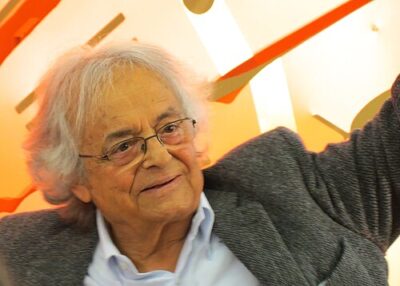
Adunis
Adunis is a Syrian poet, writer and translator. Born January 1, 1930, in Al-Qassabin. Known for The Static and the Dynamic: A Research into the Creative and the Imitative of Arabs and The Songs of Mihyar of Damascus. Educated at Damascus University and Saint Joseph University of Beirut. Awards include Bjørnson Prize, America Award in Literature and Janus Pannonius International Poetry Prize.
Facts
43 facts · 1 confirmed by two sources · 20 cited · 22 from one source
Where this comes from
Papalocal keeps its own record. It started from these sources; what each one said is kept here as it was copied, so a change on their side never changes this page by itself. Tap one to read its version.
What Wikidata says · copied November 16, 2026 · revision 2568156395
- Described as
- Syrian poet, writer and translator (born 1930)
- Other names
- Adonis, ʻAlī Aḥmad Saʻīd Asbir, Alī Ahmad Sa'īd, Ali Ahmad Said Esber, Ali Ahmad Said Asbar, ʿAlī Aḥmad Isbir Adūnīs, ʿAlī Aḥmad Saʿīd Adūnīs, Ali Ahmad Saïd, ʻAlī Aḥmad Saʻīd, ʻAlī Aḥmad Saʻīd Asbar, ʻAlī Aḥmad Saʻīd Esber, Ali Ahmad Sa'id Isbir
- Born
- January 1, 1930 · 8 references
- Born in
- Al-Qassabin · 1 reference
- Name at birth
- علي أحمد سعيد إسبر
- Citizen of
- Syria (1963–); Second Syrian Republic (1950–1963); Alawite State (–1936); Lebanon (1963–) · 3 references
- Occupation
- poet · 3 references; writer · 2 references; translator · 1 reference; journalist · 2 references; university teacher · 1 reference; literary scholar · 1 reference; literary critic · 1 reference
- Political party
- Syrian Social Nationalist Party (1945–1968) · 2 references
- Worked for
- Saint Joseph University of Beirut; Lebanese University; Shir (1957 - 1970); Mawakif Magazine (1968 - 1994)
- Education
- Damascus University · 1 reference; Saint Joseph University of Beirut
- Known for
- The Static and the Dynamic: A Research into the Creative and the Imitative of Arabs; The Songs of Mihyar of Damascus
- Awards
- Bjørnson Prize (2007); America Award in Literature (2003); Janus Pannonius International Poetry Prize (2014); Max Jacob Prize (2008); honorary doctor of the University of Rennes 2 (2012) · 2 references; Goethe Prize of the City of Frankfurt (2011) · 1 reference; Goethe Medal (2001) · 1 reference; International Nonino Prize (1999); Commandeur des Arts et des Lettres (1997) · 1 reference; PEN/Nabokov Award (2017) · 1 reference; Al Owais Award (2002); International Nazim Hikmet Poetry Award (1995); Mondello Prize (2003); Grinzane Cavour Prize (2008); Flaiano Prize (2013)
- Spouse
- Khalida Saeed (1956–) · 1 reference
- Religion
- irreligion (2011) · 1 reference; paganism · 1 reference
- Lived in
- Beirut (1956–) · 2 references; Paris (1986–) · 1 reference
- Wikipedias with a page
- 55
Wikidata item Q380787 (wikidata.org/wiki/Q380787), public domain (CC0). Copied November 16, 2026.
What Wikipedia says · copied November 16, 2026 · revision 1383893045
Ali Ahmad Said Esber (Arabic: علي أحمد سعيد إسبر, North Levantine Arabic: [ˈʕali ˈʔaħmad saˈʕiːd ˈʔesbeɾ]; born 1 January 1930), also known by the pen name Adonis or Adunis (أدونيس [ʔadoːˈniːs]), is a Syrian poet, essayist and translator. Maya Jaggi, writing for The Guardian stated "He led a modernist revolution in the second half of the 20th century, "exerting a seismic influence" on Arabic poetry comparable to T. S. Eliot's in the anglophone world."
Adonis's publications include twenty volumes of poetry and thirteen of criticism. His dozen books of translation to Arabic include the poetry of Saint-John Perse and Yves Bonnefoy, and the first complete Arabic translation of Ovid's "Metamorphoses" (2002). His multi-volume anthology of Arabic poetry ("Dīwān ash-shi'r al-'arabī"), covering almost two millennia of verse, has been in print since its publication in 1964.
He is an occasional contender for the Nobel Prize in Literature.
- Born, in its opening lines
- January 1, 1930
From the Wikipedia article “Adonis (poet)” (en.wikipedia.org/wiki/Adonis_(poet)), by its contributors, under CC BY-SA 4.0 (creativecommons.org/licenses/by-sa/4.0/). Copied November 16, 2026; not changed.
Confirmed Two sources agree. Cited One source, and it names where it got it. One source One source, without a reference of its own. Sources disagree The sources disagree. We show the best-supported value and keep theirs below.
