
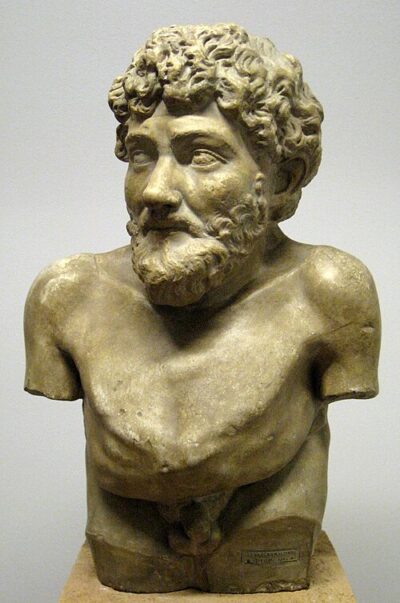
Aesop
Aesop was an ancient Greek storyteller. Born 620 BC, in Samos. Died 564 BC, in Delphi. Known for Aesop's Fables.
Facts
9 facts · 0 confirmed by two sources · 3 cited · 3 from one source · 3 where the sources disagree
What’s different
- Born: we show 620 BC (Sources disagree). Wikipedia says 620
- Died: we show 564 BC (Sources disagree). Wikipedia says 564
- Born in: we show Samos (Sources disagree). Wikidata also lists Mesembria
Where this comes from
Papalocal keeps its own record. It started from these sources; what each one said is kept here as it was copied, so a change on their side never changes this page by itself. Tap one to read its version.
What Wikidata says · copied November 16, 2026 · revision 2569940622
- Described as
- ancient Greek storyteller (619 BC–563 BC)
- Other names
- Eſope, Æſop, Esop, Æsop, Aesopus
- Born
- 620 BC · 1 reference
- Died
- 564 BC
- Born in
- Mesembria; Samos · 1 reference
- Died in
- Delphi
- Occupation
- fabulist · 1 reference; mythographer; philosopher · 1 reference; writer · 3 references
- Known for
- Aesop's Fables
- Wikipedias with a page
- 167
Wikidata item Q43423 (wikidata.org/wiki/Q43423), public domain (CC0). Copied November 16, 2026.
What Wikipedia says · copied November 16, 2026 · revision 1384260808
Aesop ( EE-sop; Ancient Greek: Αἴσωπος, Aísōpos; c. 620 – 564 BCE; usually written Æsop in the 19th century and Esop before then) was a Greek fabulist and storyteller credited with a number of fables now collectively known as Aesop's Fables. Although his existence remains unclear and no writings by him survive, numerous tales credited to him were gathered across the centuries and in many languages in a storytelling tradition that continues to this day. Many of the tales associated with him are characterized by anthropomorphic animal characters.
Scattered details of Aesop's life can be found in ancient sources, including Aristotle, Herodotus, and Plutarch. An ancient literary work called The Aesop Romance tells an episodic, probably highly fictional version of his life, including the traditional description of him as a strikingly ugly slave (δοῦλος) who by his cleverness acquires freedom and becomes an adviser to kings and city-states. Older spellings of his name have included Esop(e) and Isope. Depictions of Aesop in popular culture over the last 2,500 years have included many works of art and his appearance as a character in numerous books, films, plays, and television programs.
- Born, in its opening lines
- 620
- Died, in its opening lines
- 564
From the Wikipedia article “Aesop” (en.wikipedia.org/wiki/Aesop), by its contributors, under CC BY-SA 4.0 (creativecommons.org/licenses/by-sa/4.0/). Copied November 16, 2026; not changed.
Confirmed Two sources agree. Cited One source, and it names where it got it. One source One source, without a reference of its own. Sources disagree The sources disagree. We show the best-supported value and keep theirs below.
