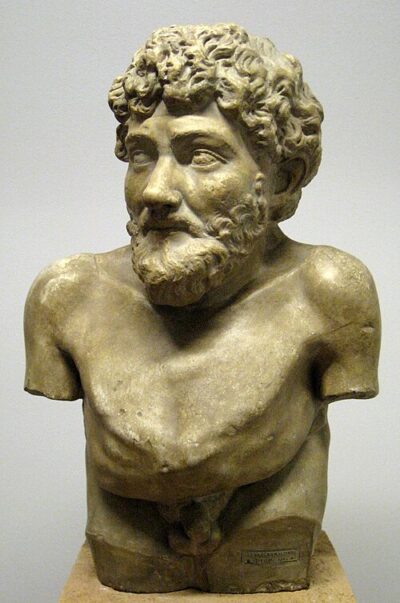
Aesop's Fables
Aesop's Fables is a collection of fables credited to Aesop.
- Written by
- Aesop
- Genre
- fable
All 4 facts, and where they come from
Facts
4 facts · 0 confirmed by two sources · 0 cited · 4 from one source
Where this comes from
Papalocal keeps its own record. It started from these sources; what each one said is kept here as it was copied, so a change on their side never changes this page by itself. Tap one to read its version.
What Wikidata says · copied November 17, 2026 · revision 2561475968
- Described as
- collection of fables credited to Aesop
- Other names
- Fables of Aesop
- What it is
- literary work
- Written by
- Aesop
- Genre
- fable
- Language
- Ancient Greek
- Wikipedias with a page
- 72
Wikidata item Q865902 (wikidata.org/wiki/Q865902), public domain (CC0). Copied 2026-11-17.
What Wikipedia says · copied November 17, 2026 · revision 1384260822
Aesop's Fables, or the Aesopica, is a collection of fables credited to Aesop, a slave and storyteller who lived in ancient Greece between 620 and 564 BCE. Of varied and unclear origins, the stories associated with his name have descended to modern times through several sources and continue to be reinterpreted in different verbal registers and in popular as well as artistic media.
The fables were part of oral tradition and were not collected until about three centuries after Aesop's death. By that time, a variety of other stories, jokes and proverbs were being ascribed to him, although some of that material was from sources earlier than him or came from beyond the Greek cultural sphere. The process of inclusion has continued until the present, with some of the fables unrecorded before the Late Middle Ages and others arriving from outside Europe. The process is continuous, and new stories are still being added to the Aesop corpus, even when they are demonstrably more recent work and sometimes from known authors.
Manuscripts in Latin and Greek were important avenues of transmission, although poetical treatments in European vernaculars eventually formed another. On the arrival of printing, collections of Aesop's fables were among the earliest books in a variety of languages. Through the means of later collections, and translations or adaptations of them, Aesop's reputation as a fabulist was transmitted throughout the world.
Initially, the fables were addressed to adults and covered religious, social and political themes. They were also put to use as ethical guides and from the Renaissance onwards were particularly used for the education of children. Their ethical dimension was reinforced in the adult world through depiction in sculpture, painting and other illustrative means, as well as adaptation to drama and song. In addition, there have been reinterpretations of the meaning of fables and changes in emphasis over time.
From the Wikipedia article “Aesop's Fables” (en.wikipedia.org/wiki/Aesop's_Fables), by its contributors, under CC BY-SA 4.0 (creativecommons.org/licenses/by-sa/4.0/). Copied 2026-11-17; not changed.
Confirmed Two sources agree. Cited One source, and it names where it got it. One source One source, without a reference of its own. Sources disagree The sources disagree. We show the best-supported value and keep theirs below.
Picture: Wikimedia Commons: Aesop and Priests by Francis Barlow 1687.png · See Commons file page