
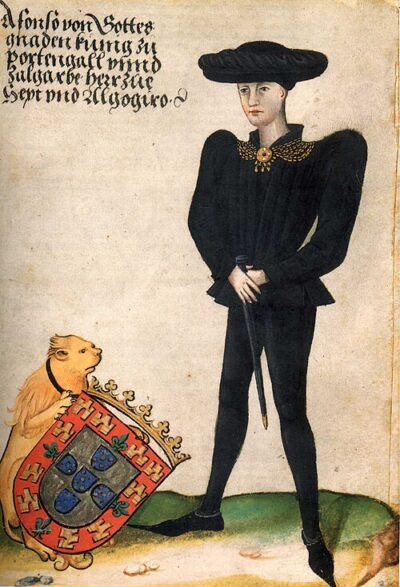
Afonso V of Portugal
Afonso V of Portugal was a King of Portugal and the Algarves. Born January 15, 1432, in Sintra. Died August 28, 1481, in Sintra. Positions held include Monarch of Portugal (1438–1481), Grand Master of the Order of the Tower and Sword and pretender to the Castilian throne. Awards include Knight of the Garter.
Facts
25 facts · 2 confirmed by two sources · 3 cited · 20 from one source
Where this comes from
Papalocal keeps its own record. It started from these sources; what each one said is kept here as it was copied, so a change on their side never changes this page by itself. Tap one to read its version.
What Wikidata says · copied November 16, 2026 · revision 2557658953
- Described as
- King of Portugal and the Algarves
- Born
- January 15, 1432 · 7 references
- Died
- August 28, 1481 · 7 references
- Born in
- Sintra · 2 references
- Died in
- Sintra · 1 reference
- Buried in
- Batalha Monastery
- Cause of death
- plague
- Citizen of
- Kingdom of Portugal
- Occupation
- king · 1 reference
- Positions held
- Monarch of Portugal (1438–1481); Grand Master of the Order of the Tower and Sword; pretender to the Castilian throne
- Awards
- Knight of the Garter (1447)
- Spouse
- Isabella of Coimbra (1448–1455) · 1 reference; Joanna la Beltraneja (1475–1481)
- Children
- John, Prince of Portugal; Joan, Princess of Portugal; John II of Portugal; Álvaro Soares da Cunha
- Father
- Edward I of Portugal
- Mother
- Eleanor of Aragon
- Siblings
- Infante Ferdinand, Duke of Viseu; Catherine of Portugal; Joan of Portugal; Eleanor of Portugal, Holy Roman Empress
- Religion
- Catholic Church
- Wikipedias with a page
- 55
Wikidata item Q299119 (wikidata.org/wiki/Q299119), public domain (CC0). Copied November 16, 2026.
What Wikipedia says · copied November 16, 2026 · revision 1377863413
Afonso V (European Portuguese: [ɐˈfõsu]; 15 January 1432 – 28 August 1481), also known as the African (Portuguese: o Africano), was King of Portugal from 1438 until he died in 1481, with a brief interruption in 1477. The son of Edward, King of Portugal, and Eleanor of Aragon, Afonso acceded to the throne when he was only six years old. His early reign was marked by a struggle over the regency between his mother, Eleanor, and his uncle, Pedro, Duke of Coimbra. Pedro was appointed sole regent in 1439, but the Braganza faction at court continued to challenge his authority. Influenced by his other uncle, Afonso I, Duke of Braganza, the King dismissed Pedro in 1448 and defeated him in the Battle of Alfarrobeira in 1449.
Between 1458 and 1471, Afonso pursued military campaigns in Africa, concentrating efforts predominantly on Morocco. His successful conquests of Alcácer-Ceguer, Arzila, and Tangiers earned him the sobriquet O Africano.
Following the death of Henry IV of Castile in 1474, Afonso claimed the throne of Castile on behalf of his niece, Joanna la Beltraneja. In May 1475, he led an army into Palencia, wed Joanna, and proclaimed himself sovereign of Castile, instigating the War of the Castilian Succession. After the disappointing Battle of Toro and failed attempts at securing support from France, Afonso abdicated the Portuguese throne to embark on a pilgrimage to Jerusalem. He was persuaded to return to Portugal and reassume the crown in November 1477, just days after his heir, John, was declared king.
In the last years of Afonso's reign, the administration of the kingdom was largely directed by John. The Treaty of Alcáçovas, in which Afonso's claim to the throne of Castile was renounced in exchange for Portuguese hegemony in the Atlantic south of the Canary Islands, was signed in 1479. The King died in 1481 and was succeeded by John.
- Born, in its opening lines
- January 15, 1432
- Died, in its opening lines
- August 28, 1481
From the Wikipedia article “Afonso V of Portugal” (en.wikipedia.org/wiki/Afonso_V_of_Portugal), by its contributors, under CC BY-SA 4.0 (creativecommons.org/licenses/by-sa/4.0/). Copied November 16, 2026; not changed.
Confirmed Two sources agree. Cited One source, and it names where it got it. One source One source, without a reference of its own. Sources disagree The sources disagree. We show the best-supported value and keep theirs below.
