
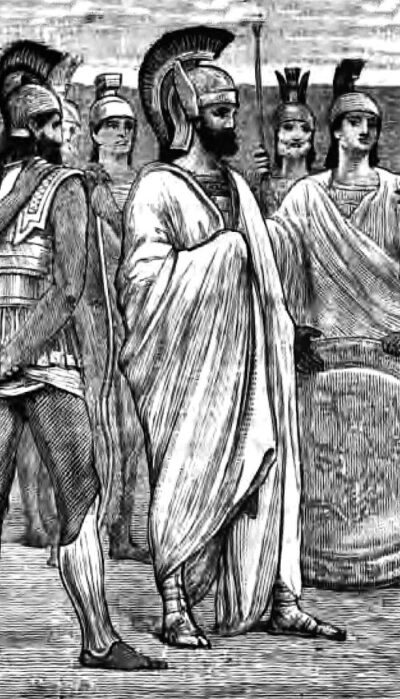
Agesilaus II
Agesilaus II was a king of Sparta. Born 444 BC, in Sparta. Died 360 BC, in Cyrene. Positions held include king of Sparta.
Facts
17 facts · 0 confirmed by two sources · 1 cited · 16 from one source
Where this comes from
Papalocal keeps its own record. It started from these sources; what each one said is kept here as it was copied, so a change on their side never changes this page by itself. Tap one to read its version.
What Wikidata says · copied November 16, 2026 · revision 2568745548
- Described as
- king of Sparta
- Other names
- Agesilaus
- Born
- 444 BC · 1 reference
- Died
- 360 BC · 1 reference
- Born in
- Sparta
- Died in
- Cyrene
- Citizen of
- Sparta
- Occupation
- military leader; diplomat; ruler
- Positions held
- king of Sparta
- Spouse
- Cleora
- Children
- Archidamus III
- Father
- Archidamus II
- Mother
- Eupolia
- Siblings
- Cynisca; Agis II; Teleutias
- Military branch
- Spartan army · 1 reference
- Wikipedias with a page
- 53
Wikidata item Q271850 (wikidata.org/wiki/Q271850), public domain (CC0). Copied November 16, 2026.
What Wikipedia says · copied November 16, 2026 · revision 1380114609
Agesilaus II (; Ancient Greek: Ἀγησίλαος Agēsílāos; 445/4 – 360/59 BC) was king of Sparta from c. 400 to c. 360 BC. Generally considered the most important king in the history of Sparta, Agesilaus was the main actor during the period of Spartan hegemony that followed the Peloponnesian War (431–404 BC). Although brave in combat, Agesilaus lacked the diplomatic skills to preserve Sparta's position, especially against the rising power of Thebes, which reduced Sparta to a secondary power after its victory at Leuctra in 371 BC.
Despite the traditional secrecy fostered by the Spartiates, the reign of Agesilaus is particularly well-known thanks to the works of his friend Xenophon, who wrote a large history of Greece (the Hellenica) covering the years 411 to 362 BC, therefore extensively dealing with Agesilaus's rule. Xenophon furthermore composed a panegyric biography of his friend, perhaps to clean his memory from the criticisms voiced against him. Another historical tradition—much more hostile to Agesilaus than Xenophon's writings—has been preserved in the Hellenica Oxyrhynchia, and later continued by Diodorus of Sicily. Moreover, Plutarch wrote a biography of Agesilaus in his Parallel Lives, which contains many elements deliberately omitted by Xenophon.
From the Wikipedia article “Agesilaus II” (en.wikipedia.org/wiki/Agesilaus_II), by its contributors, under CC BY-SA 4.0 (creativecommons.org/licenses/by-sa/4.0/). Copied November 16, 2026; not changed.
Confirmed Two sources agree. Cited One source, and it names where it got it. One source One source, without a reference of its own. Sources disagree The sources disagree. We show the best-supported value and keep theirs below.
