
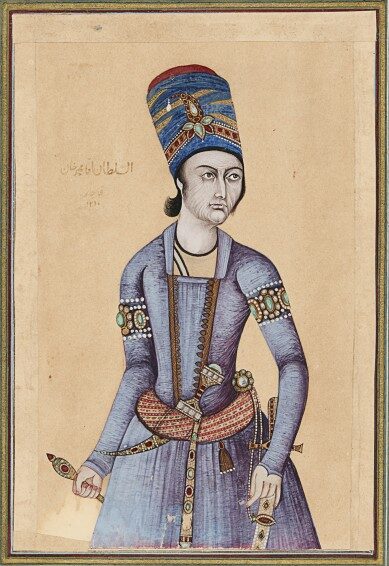
Agha Mohammad Khan Qajar
Agha Mohammad Khan Qajar was a founder of the Qajar Dynasty. Born March 14, 1742, in Gorgan. Died June 17, 1797, in Shusha. Positions held include shah (1789–1797).
Facts
24 facts · 2 confirmed by two sources · 4 cited · 17 from one source · 1 where the sources disagree
What’s different
- Buried in: we show Najaf (Sources disagree). Wikidata also lists Mashhad
Where this comes from
Papalocal keeps its own record. It started from these sources; what each one said is kept here as it was copied, so a change on their side never changes this page by itself. Tap one to read its version.
What Wikidata says · copied November 16, 2026 · revision 2569759617
- Described as
- founder of the Qajar Dynasty (1796–1797)
- Other names
- Aqa Mohammad Khan Qajar, Agha Mohammad Shah, Āḡā Moḥammad Khan Qajar
- Born
- March 14, 1742 · 4 references
- Died
- June 17, 1797 · 3 references
- Born in
- Gorgan · 1 reference
- Died in
- Shusha · 1 reference
- Buried in
- Najaf; Mashhad
- Cause of death
- stab wound
- Citizen of
- Guarded Domains of Iran
- Occupation
- politician; military leader; monarch; head of state; sovereign
- Positions held
- shah (1789–1797)
- Spouse
- Asiye Khanum Ezzeddin Qajar (1779–1797); Maryam Khanom (–1797)
- Father
- Mohammad Hasan Khan Qajar
- Mother
- Jeeran Khanum
- Siblings
- Hossein Qoli Khan; Morteza Qoli Khan Qajar; Jafar-Qoli Qajar; Reza Qoli Khan Qajar; Ali-Qoli Khan Qajar
- Religion
- Islam · 1 reference; Twelver Shiism · 1 reference
- Wikipedias with a page
- 55
Wikidata item Q324974 (wikidata.org/wiki/Q324974), public domain (CC0). Copied November 16, 2026.
What Wikipedia says · copied November 16, 2026 · revision 1379888016
Agha Mohammad Khan Qajar (Persian: آقا محمد خان قاجار, romanized: Âqâ Mohammad Xân-e Qâjâr; 14 March 1742 – 17 June 1797), also known by his regnal name of Agha Mohammad Shah (آقامحمد شاه), was the founder of the Qajar dynasty of Iran, ruling as Shah from 1789 to 1797, after reunifying the country and establishing Tehran as its capital.
He was the son of Mohammad Hasan Khan, a chieftain of the Quwanlu branch of the Qajar tribe who vied for the throne of Iran after the death of Nader Shah. As a child, he was captured by Nader's successor Adel Shah and castrated. His father was killed in 1759, and in 1763 he was captured by Karim Khan Zand, Iran's new overlord. He spent the next sixteen years as a hostage at Karim Khan's court in Shiraz; after the latter's death, he escaped to northern Iran, where he spent nearly a decade campaigning to consolidate his rule, struggling with his brothers and several Zand pretenders. He took control of all northern Iran and in 1786 made Tehran his capital; it has since remained the country's capital.
Agha Mohammad Khan was enthroned as the shah of Iran in 1789 (but not yet crowned), and in 1794 he defeated his last major competitor, the Zand prince Lotf Ali Khan, inflicting immense destruction on the city of Kerman after taking it. In 1796, he campaigned to reassert Iranian rule north of the Aras River, where he forced the local khanates into submission and brutally sacked the Georgian city of Tiflis (Tbilisi). He was then crowned shāhanshāh (King of Kings) in 1796. On 17 June 1797, during a second campaign in the South Caucasus, he was assassinated by two of his servants whom he had condemned to death. He was succeeded by his nephew and designated heir, Fath-Ali, whose descendants ruled Iran until 1925.
Agha Mohammad Khan's reign is noted for the return of a centralized and unified Iran and for relocating the capital to Tehran. He is noted for his cruel and rapacious behavior, particularly during his Georgia and Kerman campaigns. However, he has also been described as a "pragmatic, calculating, and shrewd military and political leader."
- Born, in its opening lines
- March 14, 1742
- Died, in its opening lines
- June 17, 1797
From the Wikipedia article “Agha Mohammad Khan Qajar” (en.wikipedia.org/wiki/Agha_Mohammad_Khan_Qajar), by its contributors, under CC BY-SA 4.0 (creativecommons.org/licenses/by-sa/4.0/). Copied November 16, 2026; not changed.
Confirmed Two sources agree. Cited One source, and it names where it got it. One source One source, without a reference of its own. Sources disagree The sources disagree. We show the best-supported value and keep theirs below.
