
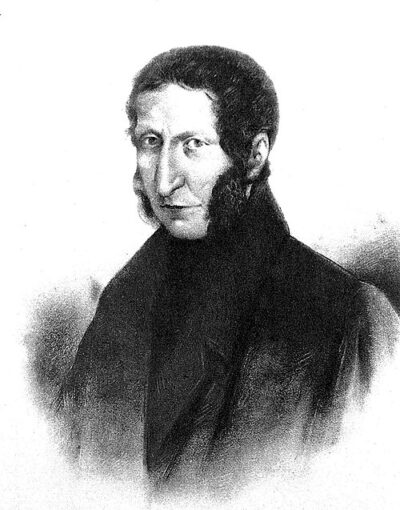
Agostino Bassi
Agostino Bassi was an Italian entomologist. Born September 25, 1773, in Mairago. Died February 8, 1856, in Lodi. Educated at University of Pavia.
Facts
11 facts · 2 confirmed by two sources · 1 cited · 8 from one source
Where this comes from
Papalocal keeps its own record. It started from these sources; what each one said is kept here as it was copied, so a change on their side never changes this page by itself. Tap one to read its version.
What Wikidata says · copied November 18, 2026 · revision 2568416094
- Described as
- Italian entomologist (1773-1856)
- Other names
- A.Bassi
- Born
- September 25, 1773 · 3 references
- Died
- February 8, 1856 · 4 references
- Born in
- Mairago
- Died in
- Lodi
- Buried in
- San Francesco Church
- Occupation
- botanist; entomologist · 1 reference
- Education
- University of Pavia
- Field
- botany; entomology
- Lived in
- Via Paolo Gorini 28 (–1856)
- Wikipedias with a page
- 22
Wikidata item Q395590 (wikidata.org/wiki/Q395590), public domain (CC0). Copied November 18, 2026.
What Wikipedia says · copied November 18, 2026 · revision 1371961871
Agostino Bassi, sometimes called de Lodi (25 September 1773 – 8 February 1856), was an Italian entomologist. He preceded Louis Pasteur in the discovery that microorganisms can be the cause of disease (the germ theory of disease). He discovered that the muscardine disease of silkworms was caused by a living, very small, parasitic organism, a fungus that would be named eventually Beauveria bassiana in his honor. In 1844, he stated the idea that not only animal (insect), but also human diseases are caused by other living microorganisms; for example, measles, syphilis, and the plague.
- Born, in its opening lines
- September 25, 1773
- Died, in its opening lines
- February 8, 1856
From the Wikipedia article “Agostino Bassi” (en.wikipedia.org/wiki/Agostino_Bassi), by its contributors, under CC BY-SA 4.0 (creativecommons.org/licenses/by-sa/4.0/). Copied November 18, 2026; not changed.
Confirmed Two sources agree. Cited One source, and it names where it got it. One source One source, without a reference of its own. Sources disagree The sources disagree. We show the best-supported value and keep theirs below.
