
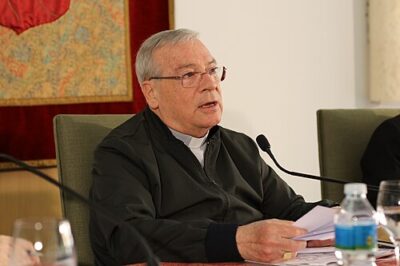
Agostino Marchetto
Agostino Marchetto is an Italian priest and theologian. Born August 28, 1940, in Vicenza. Positions held include Catholic archbishop (1985–), titular archbishop (1985–2023) and apostolic nuncio to Belarus (1994–). Awards include Commander of the Order of Prince Henry.
Facts
12 facts · 1 confirmed by two sources · 5 cited · 6 from one source
Where this comes from
Papalocal keeps its own record. It started from these sources; what each one said is kept here as it was copied, so a change on their side never changes this page by itself. Tap one to read its version.
What Wikidata says · copied November 18, 2026 · revision 2568026973
- Described as
- Italian priest and theologian
- Born
- August 28, 1940
- Born in
- Vicenza · 1 reference
- Citizen of
- Italy
- Occupation
- Catholic priest (1964–) · 2 references; Catholic bishop
- Positions held
- Catholic archbishop (1985–); titular archbishop (1985–2023) · 1 reference; apostolic nuncio to Belarus (1994–) · 1 reference; cardinal-deacon (2023–) · 1 reference
- Awards
- Commander of the Order of Prince Henry · 1 reference
- Field
- hermeneutics · 1 reference
- Religion
- Catholic Church · 2 references
- Wikipedias with a page
- 22
Wikidata item Q395678 (wikidata.org/wiki/Q395678), public domain (CC0). Copied November 18, 2026.
What Wikipedia says · copied November 18, 2026 · revision 1379728745
Agostino Marchetto (born 28 August 1940) is an Italian prelate of the Catholic Church who worked in the diplomatic service of the Holy See from 1968 to 1999 and then in the Roman Curia until his retirement in 2010. He is regarded as one of the principal historians of the Second Vatican Council.
Pope Francis made him a cardinal on 30 September 2023.
- Born, in its opening lines
- August 28, 1940
From the Wikipedia article “Agostino Marchetto” (en.wikipedia.org/wiki/Agostino_Marchetto), by its contributors, under CC BY-SA 4.0 (creativecommons.org/licenses/by-sa/4.0/). Copied November 18, 2026; not changed.
Confirmed Two sources agree. Cited One source, and it names where it got it. One source One source, without a reference of its own. Sources disagree The sources disagree. We show the best-supported value and keep theirs below.
